
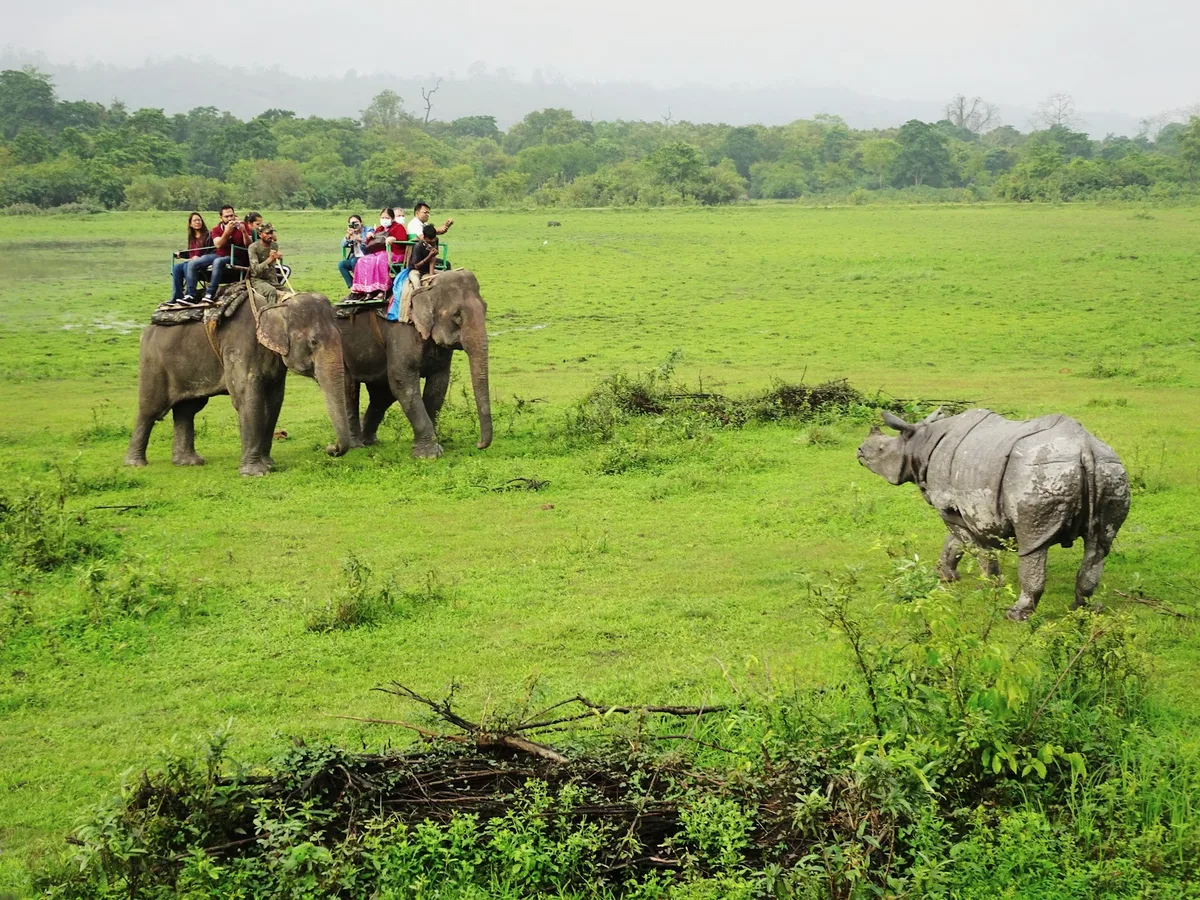
Kaziranga holds roughly two thirds of the world’s one horned rhinos in a floodplain about the size of Greater London. That density is why a Kaziranga safari is one of the few wildlife experiences in India where the headline animal is close to guaranteed rather than hoped for. People who spend a week in tiger reserves without a sighting will see rhinos here before breakfast on day one.
What is not guaranteed is that you book the right range, at the right time, in the right season. The park splits into four ranges with genuinely different characters, and the difference between a good morning and a wasted one usually comes down to which gate you chose. Axomor’s place data lists the park as open 6:00 AM to 4:30 PM with best months from October through April, and this guide covers the rest.
The Season: When the Park Is Open
Kaziranga closes for monsoon. The park typically opens around the start of November and shuts in mid April, though exact dates shift year to year with the floods and are announced by the Assam Forest Department.
This is the single most important fact in this guide. From mid April to the end of October there is no safari. The Brahmaputra floods the grasslands, animals move to the highlands along the National Highway, and the park is closed to visitors. Travellers arrive in July every year having planned a Kaziranga stop, and there is nothing anyone can do for them.
Within the open season:
- November to December: grass still tall in places, cool mornings, excellent light
- January to February: the sweet spot. Shortest grass, best visibility, animals concentrated at water
- March to mid April: warmer, occasional controlled burning of grassland, still very good
The Four Ranges Compared
Kaziranga is divided into four safari ranges. Each has its own gate, its own permit counter, and its own personality.
Kohora (Central Range) is the default. It is the closest to the main tourist strip on NH 37, has the most infrastructure, and offers the highest rhino density of the four. If you are doing one safari, do this one. It is also the busiest, so expect other vehicles at good sightings.
Bagori (Western Range) is the one experienced visitors pick. Open grassland, wide views, and consistently strong rhino and wild buffalo sightings. Many photographers prefer it to Kohora because the sightlines are longer and the vehicle traffic is lighter.
Agoratoli (Eastern Range) is the birding range. Wetlands, more water, and the best chance of seeing the park’s water birds along with rhino. If you have three safaris, make one of them here. If you have one, do not.
Burapahar (Western Extremity) is the quietest and the most forested, with hills rather than pure floodplain. Lower rhino numbers, but it is where you go if crowds bother you more than sightings do.
The practical recommendation: two safaris, one morning at Bagori and one morning at Kohora. Skip afternoons if you must choose.
Jeep Safari vs Elephant Safari
Jeep safaris run twice daily, roughly 7:00 AM to 9:30 AM and 1:30 PM to 3:30 PM, with exact timings shifting through the season. A jeep seats six. You pay for the vehicle, the range entry, a compulsory guide, and camera charges separately. Our place data records entry in the Rs 100 to Rs 500 band for Indian nationals and Rs 500 to Rs 2,000 for foreign nationals, with vehicle, camera and guide charged on top and rates varying by range.
Elephant safaris run early, usually two short slots between about 5:30 AM and 7:30 AM, and last around an hour. They go where jeeps cannot, into tall grass, and get closer to rhino than any vehicle will. Slots are limited, sell out fastest, and are allocated by an advance booking system.
There is an ethical question here that is worth naming rather than dodging. Elephant rides in wildlife tourism have drawn increasing criticism over welfare, and some visitors decline them on that basis. Kaziranga’s elephants are largely forest department animals with mahouts who have worked with them for years, which is a different situation from commercial riding operations elsewhere in Asia. You can make your own call. The jeep safari alone is more than enough to see the park properly.
How to Book
Book online through the Assam Forest Department’s official portal, or through your accommodation, which is what most visitors end up doing because the resorts have standing relationships with jeep operators.
The steps:
- Pick your date and range. Peak season mornings at Kohora and Bagori go first.
- Book the jeep, which is per vehicle rather than per person, so a group of six splits the cost.
- Pay the range entry fee, camera fee and guide fee at the gate or with the booking.
- Carry photo ID for every person in the vehicle. It is checked at the gate.
- Arrive at the gate 20 to 30 minutes before your slot.
For elephant safaris, book as far ahead as the portal allows. In December and January these are gone weeks in advance.
If you are travelling in peak season without a booking, your resort can usually still find you a jeep. What it cannot find you is an elephant slot or a Bagori morning on a Saturday.
What You Will Actually See
Rhino sightings are close to certain. In a two hour morning at Kohora or Bagori in January, ten to twenty rhino is a normal count, sometimes considerably more.
Also common: wild water buffalo, swamp deer, hog deer, wild boar, and a long list of birds including the greater adjutant stork. Elephants are frequently seen, in herds.
Tigers exist in Kaziranga at a genuinely high density, and are seen rarely. The grass is tall and the cats are unbothered by being unseen. Treat a tiger as a lottery win, not an expectation.
The park is a UNESCO World Heritage Site and its conservation record with the rhino is one of the real success stories of Indian wildlife management, having brought the species back from a few dozen animals a century ago.
How to Get There
Kaziranga sits on National Highway 37 in Assam’s Golaghat and Nagaon districts, with the main visitor strip at Kohora.
From Guwahati it is roughly 195 km and 4.5 to 5 hours by road. Jorhat is closer at around 100 km, about 2.5 hours, and Jorhat airport is the quickest air connection if the schedule suits. Most visitors drive from Guwahati.
No permit is required. Assam has no ILP, and our place data confirms no permit requirement for the park itself.
The natural pairing is with Majuli, the river island three hours further east, or with Pobitora Wildlife Sanctuary closer to Guwahati at 60 km, which has the highest rhino density per square kilometre anywhere and works as a half day trip if you cannot spare the time for Kaziranga.
Where to Stay
Accommodation clusters around the Kohora gate along NH 37, ranging from forest department lodges to mid range resorts to a handful of high end properties. Staying at Kohora puts you closest to the central range gate and the permit office.
If you are prioritising Bagori, there are options nearer the western range that save you a 20 minute pre dawn drive, which matters more than it sounds when your jeep leaves at 6:45 AM.
Book well ahead for December and January. Rates roughly double in peak season and the better places sell out.
Best Time to Visit
January and February are the best safari months, with short grass and concentrated wildlife. November and December are excellent and bring the cool clear light photographers want. March to mid April still works and is quieter.
Avoid planning anything between mid April and the end of October. For how a Kaziranga stop fits into a wider trip, see the best time to visit Northeast India guide.
Plan Your Kaziranga Trip with Axomor
The full Kaziranga National Park page has current fees, timings, coordinates and drive times from every nearby hub, and you can browse the rest of the state through all Assam destinations.
A Kaziranga safari is the easiest wildlife win in India, provided you turn up inside the season with a morning slot at the right gate. Get those two things right and the park does the rest. If you are building a longer Assam trip around it, our best places to visit in Assam guide covers what to add on either side.
Ready to plan this trip?
Use Axomor's free trip planner to build your custom Northeast India itinerary, with distances, permits, and the best time to visit each spot.