
Assam sits at the geographic heart of Northeast India, straddling the Brahmaputra floodplain between the eastern Himalayas and the hills of Meghalaya. The best places to visit in Assam span the most accessible state in the region and, in terms of sheer variety, the hardest to summarise. Within two days of each other you can watch rhinos graze at dawn on an open savannah, cross to a river island inhabited by monks who have maintained unbroken monastic traditions for five centuries, and stand at the burial mounds of a dynasty that ruled for nearly 600 years without ever being conquered by the Mughals.
Axomor has catalogued places across all of Assam’s districts. This guide covers the destinations that actually merit the journey, with current entry fees, safari costs, and a few things most guides get wrong.
The Best Places to Visit in Assam
1. Kaziranga National Park: The World’s Rhino Capital
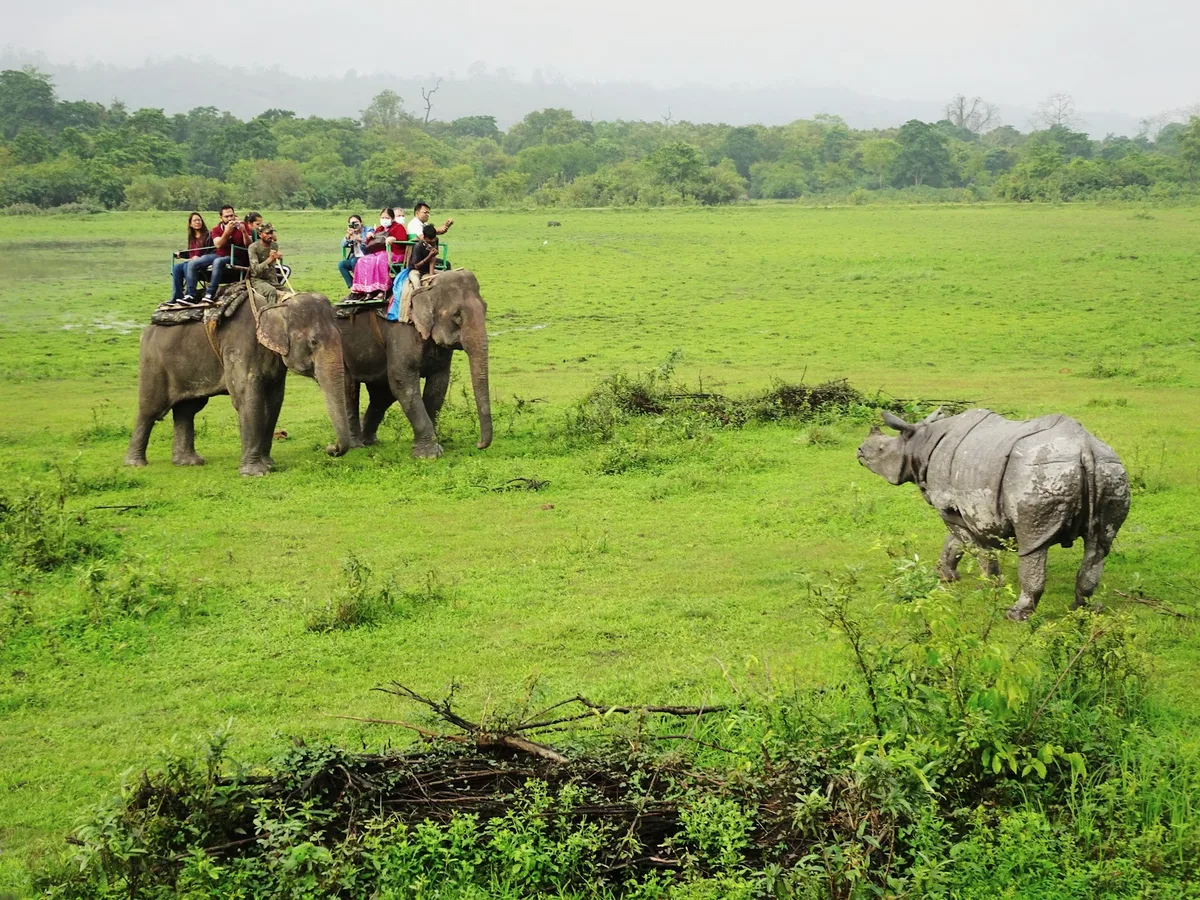
Kaziranga is the single most important reason to visit Assam. The park holds 2,613 greater one-horned rhinos as of the most recent census, approximately 64% of the entire world population of this species. It also ranks third globally in tiger density: a fact almost never mentioned in tourism content because the rhinos overshadow everything else.
A note most guides get wrong: Kaziranga is closed from May to October. The park opens on November 1 each year. If you are reading a guide that calls October a good month to visit for the safari, that is incorrect. October falls within the closed season.
The four safari zones:
| Zone | Also Known As | What It’s Best For |
|---|---|---|
| Kohora | Central Range | Highest rhino concentration; most visited |
| Bagori | Western Range | Elephants and grasslands; less crowded than Kohora |
| Agaratoli | Eastern Range | Least visited; best for birds and quieter mornings |
| Burapahar | Burapahar Range | Trekking and forest; lowest tourist traffic |
Jeep safari costs (per jeep, up to 6 people, approximately 2 hours):
| Zone | Indian | Foreign |
|---|---|---|
| Kohora (Central) | Rs 4,000 | Rs 7,700 |
| Bagori (Western) | Rs 4,000 | Rs 7,700 |
| Agaratoli (Eastern) | Rs 4,600 | Rs 8,600 |
| Burapahar | Rs 5,400 | Rs 9,700 |
Park entry is Rs 100 for Indians and Rs 650 for foreigners, in addition to the jeep cost.
Elephant safaris: These ran through the 2025-26 season in the Kohora and Bagori zones, using 47 verified elephants. They close on May 1 each season and reopen November 1. Some older guides incorrectly state they have been permanently discontinued. They have not. For the November 2026 season onwards, elephant safaris are expected to operate as normal.
The 2024 floods: Kaziranga experienced its worst flooding in a decade during July-August 2024. The park infrastructure has fully recovered for the 2025-26 season, but NH 715, which runs along the park’s southern boundary, remains subject to timed convoy restrictions during severe monsoon events. This highway cuts through the buffer zone, creating genuine wildlife-traffic conflict during peak floods. Plan your visit between November and February when roads are stable and dry-season grass reveals more animals.
- Distance from Guwahati: ~215 km, 4-5 hours via NH 715
- Best time: November-February (peak season, best visibility)
- Park open: November 1 to April 30 only
2. Majuli Island: The Sinking World Heritage
Majuli is the world’s largest river island, according to the Guinness World Record it still holds. The more important fact is that it is disappearing. At the start of the 20th century, Majuli covered over 1,200 square kilometres. Satellite data from 2023 puts the current area at approximately 474 square kilometres. The island loses around 7 square kilometres to Brahmaputra erosion every year. More than 35 villages have been washed away since 1991. Majuli became India’s first island district in 2016, partly in recognition of what may be lost.
What draws visitors is its living cultural heritage: the Vaishnavite satras, monastic institutions established in the 16th century by the saint-philosopher Srimanta Sankaradeva as part of the Bhakti movement. The satras are simultaneously monasteries, cultural academies, and performance institutions. Daily prayers, Sattriya classical dance, and Bhaona (traditional theater) continue as they have for centuries.
Auniati Satra is the largest, with around 550 resident monks. It is best known for Paalnaam devotional singing and a museum holding centuries-old Assamese artifacts, royal jewelry, and ceremonial utensils. Daily prayers have run uninterrupted here for over 350 years.
Kamalabari Satra is the intellectual centre, known for classical Sattriya dance and literature. Its branch, Uttar Kamalabari Satra, performs nationally and internationally.
How to get there: From Jorhat city, take a shared auto to Nimati Ghat (14 km, around Rs 20-30). Ferries cross to Kamalabari Ghat on Majuli in 1-1.5 hours. Departures from Nimati Ghat: 8:30 AM, 9:30 AM, 10:30 AM, 1:00 PM, 2:00 PM, 3:00 PM, and 3:30 PM. Passenger fare is Rs 25. Return ferries from Kamalabari: 7:00 AM, 7:30 AM, 8:30 AM, 10:30 AM, 12:30 PM, 1:30 PM, and 3:00 PM. During the June-September monsoon, ferry timings change and services are sometimes suspended during high-flood events.
- Distance from Guwahati: ~315 km to Jorhat, plus Nimati Ghat and ferry
- Best time: October-March; November for the Majuli Festival
- Note: The “880 sq km” figure still circulating in most guides is outdated by decades
3. Sivasagar: The Ahom Kingdom’s Capital
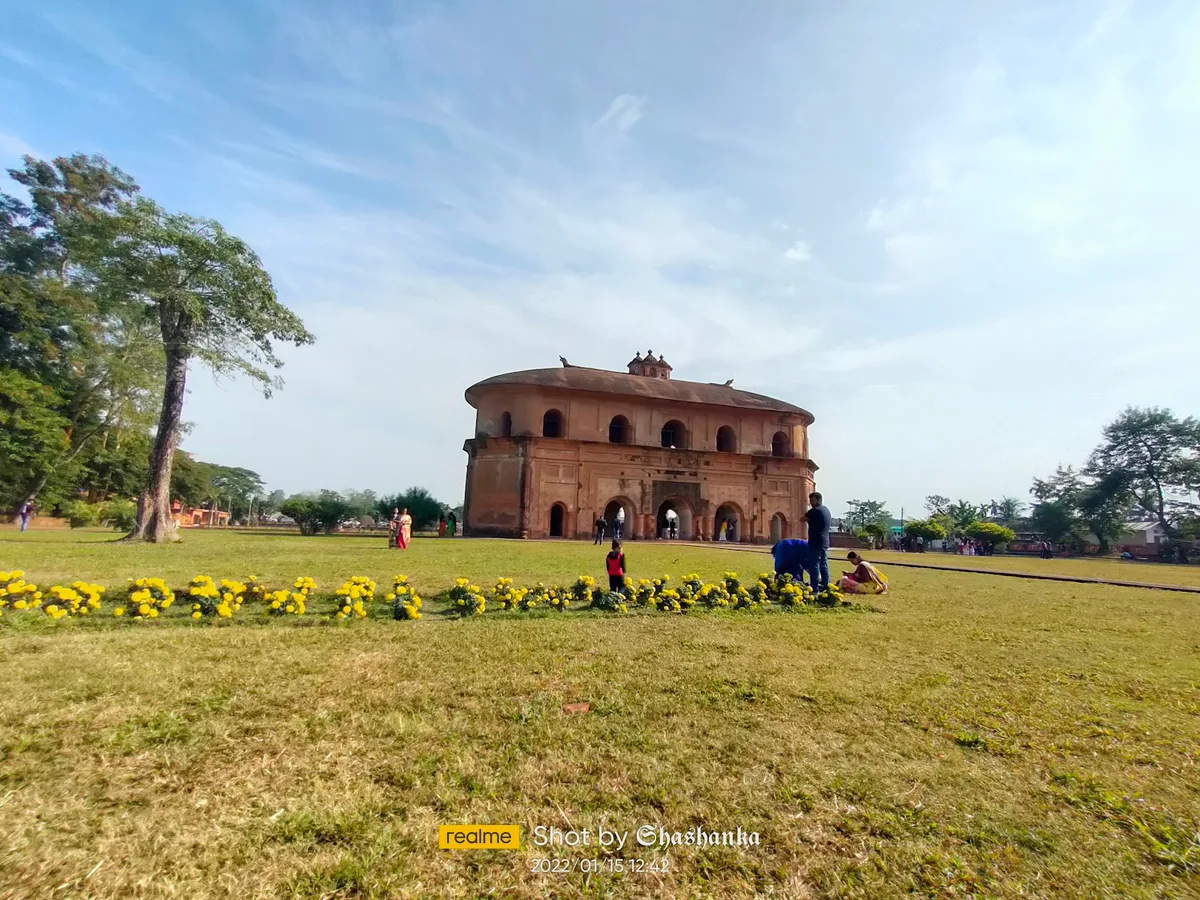
The Ahom dynasty ruled Assam from 1228 to 1826: 598 years, one of the longest dynastic reigns in Indian history. They successfully repelled 17 Mughal invasion attempts, making them one of the few powers in the subcontinent never conquered by the Mughals. The Ahoms were originally a Tai-speaking people from present-day Yunnan, China, who migrated under prince Sukaphaa and over generations adopted local culture while maintaining distinct traditions.
Sivasagar (formerly Rangpur) was the Ahom capital from 1699 to 1788. The surviving monuments are extraordinary, and largely undercrowded.
Rang Ghar is Asia’s oldest surviving amphitheater, built in 1746 by Ahom king Pramatta Singha. Oval, double-storied, with a boat-shaped roof; it was used for watching Bihu games, buffalo fights, and bird fights. Entry: Rs 25 Indians / Rs 300 foreigners.
Talatal Ghar (Rangpur Palace) is the largest surviving Ahom structure: seven stories total, with three above ground and four below ground, connected by an underground tunnel network that extended to Garhgaon 16 km away. It was a strategic military system, not merely a palace basement. Entry: approximately Rs 20 Indians / Rs 250 foreigners.
Kareng Ghar (Garhgaon Palace), 16 km from Sivasagar, was the earlier Ahom capital: a four-story octagonal brick palace. Entry: approximately Rs 20-30 Indians / Rs 200-300 foreigners.
Charaideo Maidam is 28 km from Sivasagar and deserves its own paragraph. These are the royal burial mounds of the Ahom dynasty: earthen pyramids where kings and queens were interred with their possessions, servants, and animals. In July 2024, Charaideo Maidam was inscribed as a UNESCO World Heritage Site, becoming India’s 43rd. This happened too recently for most guides to include. Charaideo is the “Pyramid field of Assam,” and the Ahom burial tradition shares conceptual parallels with Egyptian tomb-building, though the forms are entirely different.
Important distinction: The Sivasagar monuments (Rang Ghar, Talatal Ghar) are not yet UNESCO-listed. Only Charaideo Maidam received inscription in 2024. A separate Sivasagar nomination is in progress as of 2025.
- Distance from Guwahati: ~360 km northeast, 6-7 hours
- Best time: October-March
- Entry fees: Per monument, Rs 20-25 Indians; Rs 250-300 foreigners (ASI-managed)
4. Manas National Park: The Recovery Story
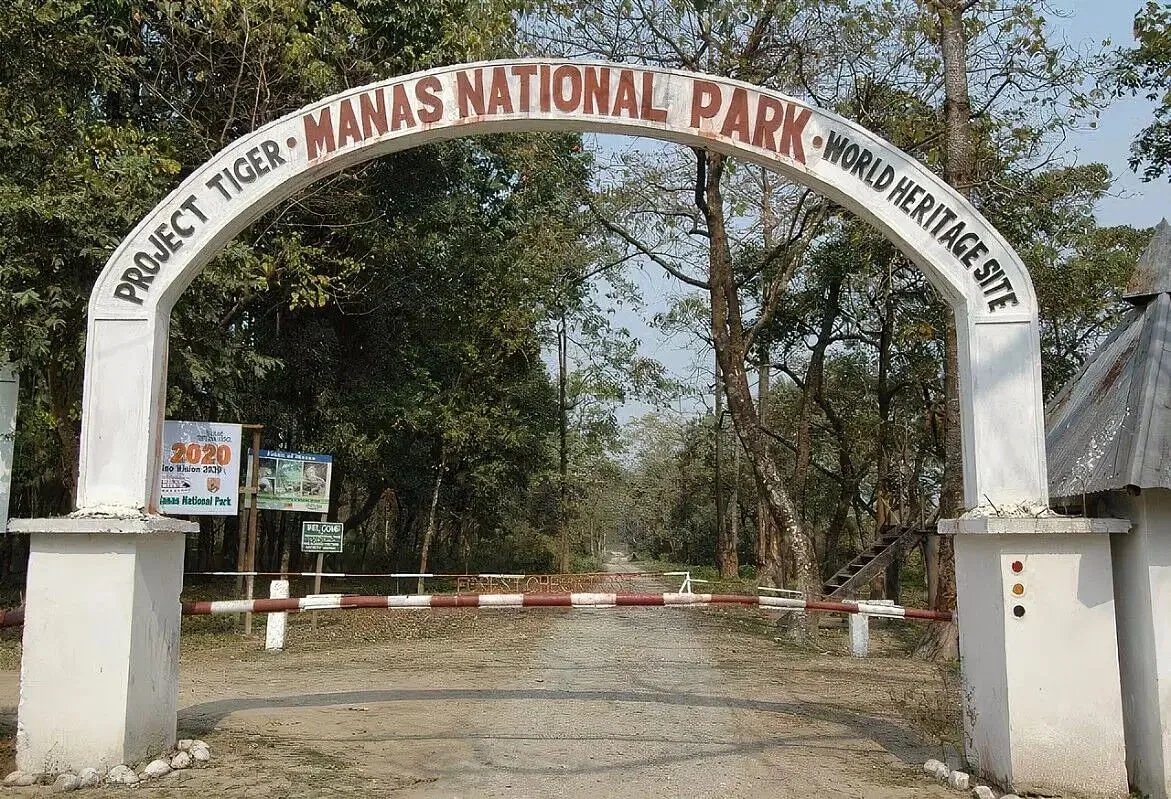
Manas received the same UNESCO World Heritage designation as Kaziranga in 1985. Then, in 1992, it was placed on UNESCO’s List of World Heritage in Danger, damaged by poaching and insurgency during one of Assam’s most troubled decades. In 2011, after sustained conservation effort and political stabilisation, it was removed from the Danger List. That recovery arc is one of wildlife conservation’s genuine success stories in India, and almost no tourism guide mentions it.
Manas is fundamentally different from Kaziranga in terrain and experience. Where Kaziranga is open grassland on a floodplain, Manas is dense tropical forest pressing up against the Himalayan foothills. The park continues north into Royal Manas National Park in Bhutan, one of the few transboundary UNESCO World Heritage areas in South Asia.
Manas holds species not found at Kaziranga: the golden langur (found nowhere else in India outside this immediate region), clouded leopard, pygmy hog, and hispid hare. Tiger and elephant are present but forest density means sightings require patience. For wildlife enthusiasts who want a less commercial, more genuinely wild experience than Kaziranga, Manas is the better choice.
Safari costs:
| Zone | Indian (per jeep) | Foreign (per jeep) |
|---|---|---|
| Bansbari | Rs 4,500 | Rs 8,500 |
| Bhuyanpara | Rs 5,900 | Rs 9,000 |
Elephant safari: Rs 1,400/person Indians / Rs 3,200/person foreigners (Bansbari, 1 hour). River rafting on the Manas River is also available, unusual for a wildlife park and one of Manas’s distinctive features.
Park entry: Rs 20 Indians / Rs 250 foreigners. Camera: Rs 50 / Rs 500.
- Distance from Guwahati: ~134 km to park boundary, 3.5-4 hours
- Park open: November-April
- Best time: November-February
5. Tezpur: City of Blood, Gateway to Nameri
Tezpur sits on the north bank of the Brahmaputra, 177 km northeast of Guwahati. Its name means “City of Blood” in Assamese (tez meaning blood), from the mythological battle between Shiva’s forces and Krishna’s army described in the Mahabharata, fought near King Banasura’s palace here.
Agnigarh is the main sight: a terraced hill-garden with murals and sculptures depicting the Usha-Aniruddha legend, where King Banasura imprisoned his daughter Usha to prevent her prophesied romance. The spiral path to the summit gives panoramic views over the Brahmaputra. About 5 km from town centre.
Bamuni Hills, a short walk from Agnigarh, holds 9th-10th century carved stone temple ruins on the Brahmaputra bank, significant archaeologically and almost entirely absent from mainstream guides.
Nameri National Park is 37 km north of Tezpur at the Assam-Arunachal Pradesh border. Known for elephants, tigers, and rare birds (including the white-winged wood duck), it also offers river rafting on the Jia Bhoroli river. Nameri is a genuine alternative to Kaziranga for visitors coming from Guwahati who want a less-visited wilderness experience.
- Distance from Guwahati: ~177 km, 4 hours
- Best time: October-April for Nameri; Tezpur sights year-round
6. Haflong: Assam’s Only Hill Station
Haflong is the headquarters of Dima Hasao district in the Barail Hills, the only true hill station within Assam proper. At around 600-800 metres elevation, it is noticeably cooler than the Brahmaputra valley and set among rolling forested hills. Haflong Lake, in the town centre, attracts migratory birds in winter and makes for pleasant early morning walks.
The train journey from Guwahati to New Haflong (station code NHLG) is one of the most scenic rail routes in Northeast India, passing through the Dima Hasao hills. Multiple daily trains run the route; fastest is approximately 5.5 hours. If you have the time, the train is a better reason to visit than the town itself.
Jatinga village, 9 km south of Haflong, is the site of a genuine and documented natural phenomenon: during September to November, on dark, foggy, moonless nights, migratory birds become disoriented by artificial lights, fly toward fires and lamps, and crash or are caught. The phenomenon has been documented by ornithologists since the 1950s and is listed by the state government as a tourist attraction. It is not “bird suicide”: the scientific explanation is fog-induced navigation disruption, not mass self-destruction. Guided visits happen during the October-November new moon period.
- Distance from Guwahati: ~328 km by road; ~281 km by rail
- Best time: October-March for pleasant weather; September-November for Jatinga
- Train: Guwahati to New Haflong; check current schedule for timings
7. Jorhat: Tea Capital and Majuli Base
Jorhat is the practical base for Majuli and the launch point for one of Assam’s more unusual sights. At Nimati Ghat, 14 km from the city centre, you board the ferry to the island. Most visitors stay in Jorhat and do Majuli as a day trip, though an overnight in one of Majuli’s village homestays gives the island a different character entirely.
Tocklai Tea Research Institute (established 1911) is the world’s oldest and largest tea research station. Guided visits are possible and genuinely interesting for anyone who drinks tea and wants to understand how varieties and processing methods are developed.
Dhekiakhowa Bornamghar, a Vaishnavite prayer hall established by Srimanta Madhabdev in 1461, reportedly has an earthen lamp that has burned continuously for over 560 years. This is verifiable and remarkable. It is almost never mentioned in mainstream travel writing about Jorhat.
Gibbon Wildlife Sanctuary, 20 km from Jorhat, is a small sanctuary home to Hoolock gibbons, the only ape species in India. An easy half-day visit if you are based in Jorhat.
- Distance from Guwahati: ~305 km, 5-6 hours
- Best time: October-March
8. Dibrugarh and Dibru-Saikhowa: Tea Country’s Edge
Dibrugarh is the largest city in Upper Assam, set on the Brahmaputra’s south bank with the Arunachal foothills visible to the north. The tea garden landscape here is more expansive and less touristed than around Jorhat, and the city has a functional colonial-era character that retains some of Assam’s old planter town atmosphere.
Dibru-Saikhowa National Park, straddling Dibrugarh and Tinsukia districts, is India’s only national park with a significant population of feral horses. These are descendants of British Army horses abandoned after World War II, gone wild on the river island. The park also holds the endangered white-winged wood duck, and access involves boat safaris on the Brahmaputra tributaries. A 2025 report by East Mojo found the park shrinking due to unabated river erosion; its actual current extent is considerably smaller than the listed 340 square kilometres. The NGT has taken cognizance of the declining feral horse population.
Namphake village, near Dibrugarh on the Burhi Dihing River, is a Tai Phake tribal settlement with stilt houses and a traditional Theravada Buddhist vihara, a living community that traces its roots to the same Tai-speaking migration that brought the Ahom dynasty to Assam.
- Distance from Guwahati: ~439 km, 7-8 hours
- Distance from Tinsukia: ~50 km, 1.25 hours
- Best time: October-March
9. Guwahati: The Gateway
Guwahati is covered in depth in our Guwahati tourist places guide. As Assam’s largest city and the main gateway into Northeast India, it is where most trips begin. Kamakhya Temple, Umananda Island, Pobitora Wildlife Sanctuary (48 km away, the highest rhino density of any protected area in the world), and Brahmaputra river cruises are the primary draws.
10. Silchar and Barak Valley
Silchar is the main urban hub of Barak Valley in southern Assam, a linguistically and culturally distinct region that connects to Mizoram and Manipur. It is not typically on the standard Assam tourist circuit but serves as the gateway for travellers moving between the northeast hill states and the Brahmaputra valley. The Barak River is a different river system from the Brahmaputra; broader Assam is divided between these two major watersheds.
Best Time to Visit Assam
| Activity | Best Months | Notes |
|---|---|---|
| Kaziranga rhino safari | November-February | Park opens November 1, not October |
| Elephant safari at Kaziranga | November-April | Closes May 1; reopens November 1 |
| Majuli satras and culture | October-March | Majuli Festival in November |
| Manas National Park | November-April | Mirrors Kaziranga season |
| Brahmaputra river cruises | October-April | Luxury cruise season aligned with park opening |
| Jatinga bird phenomenon | September-November | Dark/moonless nights; peaks October-November |
| Tezpur, Sivasagar, history sites | October-March | Year-round but most comfortable in this window |
| Tea garden visits | October-March | Active harvest season; best weather |
| Rongali Bihu Festival | April | Assamese New Year; the most lively cultural celebration |
| Bhogali Bihu (Magh Bihu) | January | Harvest festival, community feasts |
| Haflong hill station | October-March | Hill station pleasant; avoid heavy monsoon |
One constraint to plan around: Both Kaziranga and Manas are open November 1 to April 30 only. Any Assam trip that includes wildlife safari must fall within this window. Guides that describe October as “ideal for Kaziranga” are working from incorrect information.
How to Get to Assam
By Air: Guwahati’s Lokpriya Gopinath Bordoloi International Airport (GAU) is the main hub, well connected from Delhi, Kolkata, Mumbai, Bangalore, and Hyderabad. Dibrugarh has a domestic airport (DIB) serving Upper Assam and useful for eastern circuits. Silchar airport (IXS) serves Barak Valley.
By Rail: Guwahati is a major junction on the Northeast Frontier Railway. Direct overnight trains from Kolkata (12-14 hours), Delhi (27-36 hours), and connections from most major Indian cities. For Upper Assam, trains continue to Jorhat Town, Dibrugarh, and Tinsukia stations. The New Haflong (NHLG) station is on a scenic mountain branch line from Guwahati.
By Road: NH 715 (formerly NH 37) is the main arterial road through the Brahmaputra valley, running from Guwahati eastward through Kaziranga to Jorhat, Dibrugarh, and Tinsukia. It passes along Kaziranga’s southern boundary: a scenic drive in the dry season but subject to convoy restrictions during severe flooding.
No Permits Required
Unlike Arunachal Pradesh, Assam requires no Inner Line Permit for Indian or foreign nationals. Standard ID for Indians; valid Indian visa for foreigners.
How to Plan Your Assam Trip
A 7-day western circuit from Guwahati:
- Day 1: Arrive Guwahati, Kamakhya Temple, evening on the Brahmaputra
- Day 2: Guwahati to Kaziranga (215 km)
- Day 3: Kaziranga morning safari (Kohora zone) and afternoon safari (Bagori zone)
- Day 4: Kaziranga to Jorhat (80 km); evening visit to Tocklai Institute
- Day 5: Morning ferry to Majuli, visit Auniati and Kamalabari Satras, return to Jorhat
- Day 6: Jorhat to Sivasagar (50 km); Rang Ghar, Talatal Ghar, Charaideo Maidam
- Day 7: Return to Guwahati or continue to Dibrugarh
For Manas: Add a 2-day extension from Guwahati: 134 km northwest, easy to pair with Guwahati before heading east toward Kaziranga.
For Haflong: Best added as a 2-night extension by train from Guwahati, or as a stopover on the road between Guwahati and Silchar.
Explore all Assam destinations and use Axomor’s trip planner to build your route with distances and timing.
Deeper on Assam

Written by
Kundan GuptaWrites from Assam. Checks fares and fees in person before publishing.
Kundan Gupta runs Axomor and edits its Northeast India coverage. He is responsible for the accuracy of the guides published here, including checking permit rules, fees and travel logistics against primary sources before they go live.
Ready to plan this trip?
Use Axomor's free trip planner to build your custom Northeast India itinerary, with distances, permits, and the best time to visit each spot.