
Shillong sits at 1,500 metres in the Khasi Hills, a compact city of around 400,000 people spread across a series of ridges with steep valleys between them. The Shillong tourist attractions range far beyond the standard hill-station checklist: the city is the capital of Meghalaya, the natural base for exploring the state, and, by a genuine claim rather than marketing invention, one of the most musically significant cities in India. The Khasi people who make up the majority of Shillong’s population follow one of the few matrilineal societies in South Asia: property, clan identity, and inheritance pass through the female line, and the youngest daughter of a family inherits the home. This shapes the city’s social character in ways that become visible over a few days.
Most visitors come to Shillong as a base for Cherrapunji and Dawki. The city itself rewards more time than that.
Tourist Places in Shillong
Don Bosco Museum of Indigenous Cultures
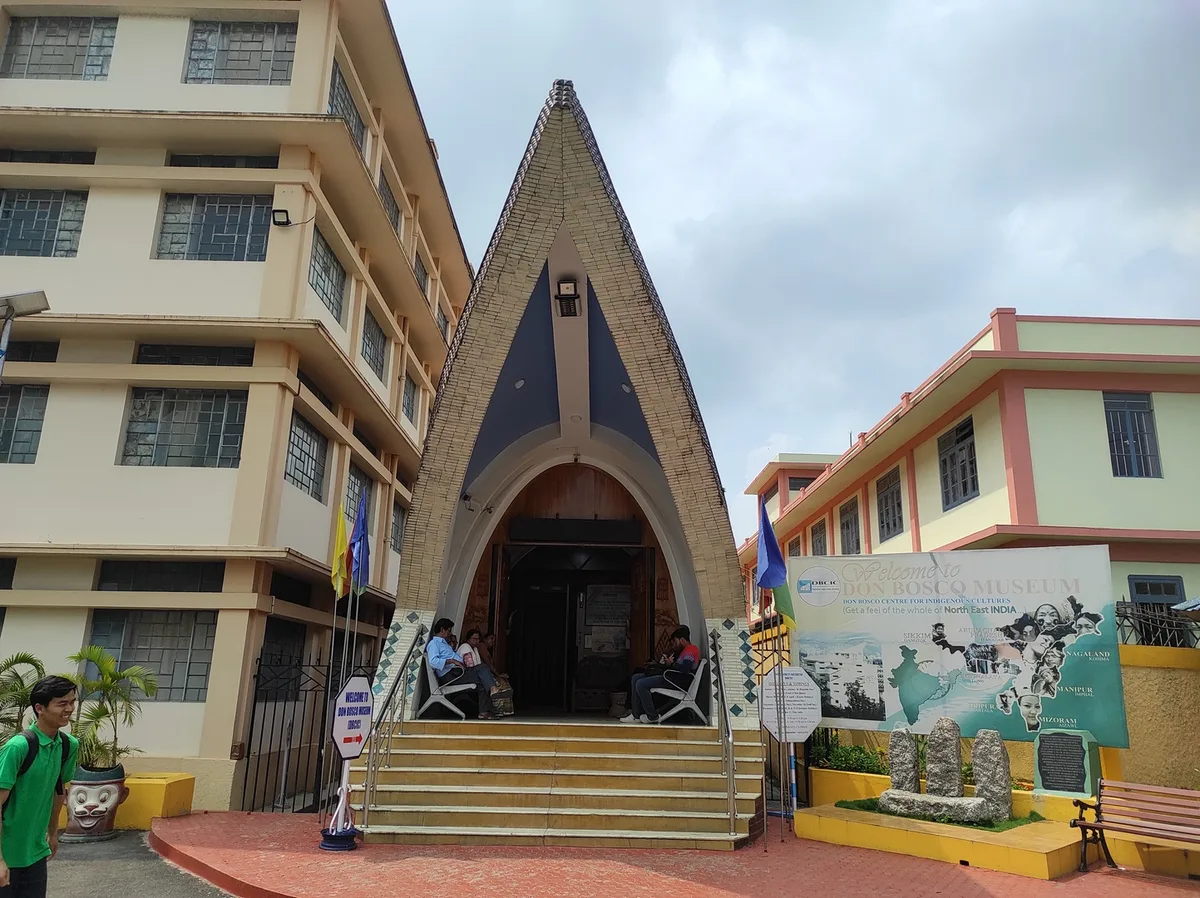
The Don Bosco Museum is the best cultural museum in Northeast India and makes a case for being one of the best in Asia. Seven floors, over 18 thematic galleries, thousands of artefacts, and the most thorough documentation of Northeast India’s tribal cultures under one roof. It covers all seven northeastern states: Assam, Meghalaya, Manipur, Mizoram, Nagaland, Tripura, and Arunachal Pradesh.
What’s on each floor:
- Ground Floor: Origins and Pre-History: fossils, archaeological finds, migration patterns of Northeast India’s first peoples
- Floor 1: Agriculture and Livelihoods: jhum (slash-and-burn) cultivation, wet rice terracing, traditional tools and dioramas
- Floor 2: Arts and Crafts: handloomed textiles, bamboo and cane work, metalwork, pottery
- Floors 3-6: Rotating thematic galleries covering tribal costumes, traditional house types, musical instruments, weapons, and regional flora and fauna; each broadly corresponds to one of the seven states
- Floor 7: The skywalk, a circular observation deck with 360-degree views of Shillong city, the Khasi Hills, and on clear days the Bangladesh plains extending south
That top-floor skywalk is one of the more unusual design choices in any Indian museum: you end a seven-floor cultural journey with a panoramic view of the living landscape the museum has been contextualising. Worth knowing before you go.
Entry: Rs 100 adults (Indians) / Rs 200 foreigners; Rs 50 students. Camera: Rs 100 extra. Hours: Monday-Saturday, 9:30 AM-5:30 PM (February to November). Closed Sundays and December-January; confirm before visiting in shoulder months. Allow: 2-3 hours minimum.
Ward’s Lake
Ward’s Lake is Shillong’s colonial-era centrepiece: a horseshoe-shaped artificial lake built in 1894, planned by Chief Commissioner Sir William Ward, designed by F.T. Pollok, and built by Colonel Hopkins. The cobblestone walking paths around the perimeter are original British-era infrastructure. A wooden footbridge crosses the water at the narrowest point, the standard photo spot, and worth it for the fish visible below the surface on calm mornings.
The surrounding botanical garden has orchids and diverse Himalayan flora. Boating (pedal and row) is available for hire. Admission is Rs 10 (Rs 5 for seniors and differently-abled visitors), still one of the cheapest entry-fee attractions in India. Hours: 8:30 AM-7 PM (March-October); 8:30 AM-5:30 PM (November-February).
During the November Cherry Blossom Festival, a Japan Arena cultural zone operates at Ward’s Lake celebrating the Meghalaya-Japan cultural connection. The Prunus cerasoides (wild Himalayan cherry) that blooms in Shillong is from the same genus as Japan’s sakura, and the parallel has become a formal cultural exchange.
Shillong Peak: The City’s Sacred Summit
Shillong takes its name from Lei Shyllong, a deity the Khasi people believe resides at this hilltop. The spiritual origin of the city’s name and its most famous viewpoint being at the same place is something almost no travel guide mentions.
The peak sits at approximately 1,965 metres, about 10 km from the city centre, and is controlled by the Indian Air Force’s Eastern Air Command. The access road passes through an active radar station.
Practical logistics that matter:
- Closed every Wednesday: this is firm and non-negotiable; plan around it
- Foreign nationals cannot visit: this is an active restricted military zone
- Indian visitors need a valid government photo ID (Aadhaar or Voter ID)
- Private vehicles are stopped at the entry gate; visitors hire IAF-approved local taxis (approximately Rs 200 per car, round trip) from the gate
- Photography of the base infrastructure is prohibited during the drive; camera use is permitted only at the designated viewpoint area
- Close by 3:30 PM at the latest: some sources cite later timings, but entry passes stop being issued well before afternoon
On a clear morning, the views extend over the entire Shillong cityscape, Umiam Lake, and the Khasi Hills rolling toward Bangladesh. Entry: approximately Rs 30 per person plus Rs 30 vehicle fee.
Elephant Falls
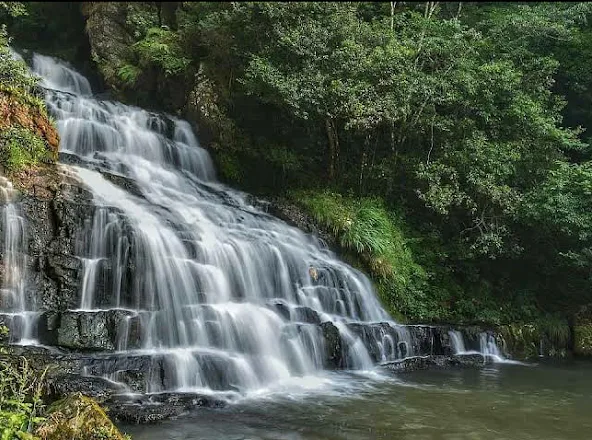
Elephant Falls is about 12 km from Shillong city centre. Its Khasi name, Ka Kshaid Lai Pateng Khohsiew, means “the three-step waterfall,” which describes what it is precisely. The English name came from a British-era rock formation near the falls that resembled an elephant. That rock was destroyed in the 1897 earthquake. The elephant no longer exists, but the name stuck.
The three tiers are all accessible via maintained staircase pathways:
- Tier 1 (topmost): Wide and bowl-shaped; partially obscured by trees; the least dramatic of the three, particularly outside monsoon
- Tier 2 (middle): More contained; in the dry season (November-February) it is modest
- Tier 3 (lowest): The most photogenic, with clear water falling over irregular rocks into a pool you can stand beside
Best season: June-September monsoon for full flow across all three tiers. October onwards for easier access but reduced upper tiers. Entry: approximately Rs 20-30 plus Rs 20 camera fee. Hours: 8 AM-5 PM daily.
Police Bazar: The City Centre
Police Bazar (or Khyndailad/Iewduh in Khasi) is not a single market but the dense grid of streets that forms Shillong’s central commercial district. Shops open around 9 AM and run to 8 PM most days.
What to buy: Handloomed Khasi shawls and traditional fabrics, bamboo and cane handicrafts, locally foraged products (orange honey, dried herbs, jams), Korean and Japanese cosmetics that arrive through Meghalaya’s cross-border trade channels.
What to eat: Jadoh, rice cooked with pork, ginger flower, and mint, is the Khasi staple and the single most important thing to eat in Shillong. Find it near Don Bosco Square or in the lanes around Trattoria. Tungrymbai is fermented soybean, hyper-local, found essentially nowhere else in India. Pork momos, chaat stalls, and chicken cutlets from street vendors fill out the options.
Versus MG Marg in Gangtok: MG Marg is cleaner, pedestrianised, well-lit, with international retail brands; designed for visitors. Police Bazar is noisier, denser, more authentic, and better for local food and genuine handicrafts. They serve different purposes; neither is superior to the other.
The Music Scene: Why the “Rock Capital” Claim Has Substance
Shillong has been called the “Rock Capital of India” since at least the 1990s. The claim is partly cultural branding, but the underlying history is real.
British missionary schools from the 1870s introduced Western instruments and church choral traditions to the Khasi-Jaintia population. The Khasi people, overwhelmingly Christian (Meghalaya is over 74% Christian), absorbed rock and blues through shortwave radio and smuggled vinyl in the 1960s and 70s. The Fentones won the Simla Beat Contest in the 1970s; The Great Society dominated national circuits in the 1980s.
Two achievements give the claim international credibility:
Soulmate, a blues-rock duo led by Tipriti Kharbangar on vocals and Rudy Wallang on guitar, became the first Indian band to compete at the International Blues Challenge in Memphis, Tennessee in 2007. They remain one of the most serious blues acts in South Asia.
Shillong Chamber Choir reached the semifinals of NBC’s America’s Got Talent Season 8 in 2013. A choir from a city most Americans had never heard of performed for tens of millions of viewers. It is the most globally visible cultural achievement in Shillong’s history, and it is underplayed in virtually all travel content.
Lou Majaw performs Bob Dylan tribute concerts annually at Don Bosco Square. He has done so for over 50 years.
For live music: Cloud 9 and Cafe Shillong in the Police Bazar area host regular performances. The NH7 Weekender (India’s premier indie festival) has historically held a Shillong leg in October-December.
Laitlum Canyons: The Mandatory Detour
Laitlum Canyons is 21-25 km from Shillong (about an hour by road) and appears as optional in most Shillong itineraries. It should not be optional. The views from the canyon rim are among the most dramatic anywhere in Meghalaya: deep gorges with the valley floor far below, green ridges rolling into Bangladesh’s plains on clear days, and clouds that frequently float below your feet in the morning.
“Laitlum” in Khasi means “End of Hills,” and you understand why when you stand at the rim. The hamlet of Rasong (300 residents, accessible only by an old ropeway pulley system with no road connection) is visible below, which adds human scale to the depth. This is the canyon seen in Bollywood film Rock On 2 (2016).
Entry: Free (parking fee applies). The viewpoint is a 2 km walk from the parking area. For serious trekkers, a 6 km trail descends to Smit village (4-5 hours round trip). Best time: October-April mornings; arrive by 7-8 AM to beat cloud buildup. The monsoon version is dramatically misty but the path gets slippery and visibility drops.
Mawphlang Sacred Forest
Twenty-five kilometres from Shillong (about an hour by road), Mawphlang is a forest that has never been logged or cleared, believed to have been in continuous sacred protected status for over 1,000 years. A 2026 paper in the journal Integrative Conservation studied Mawphlang specifically as a model for belief-driven biodiversity conservation, documenting over 400 plant species including 25 types of orchids, Rudraksha trees, rhododendrons, and Khasi pine.
The forest is the abode of Labasa, the local guardian deity of Niam Khasi (the indigenous Khasi religion, distinct from Christianity). Everything within is protected by religious prohibition: nothing may be removed: not a pebble, leaf, flower, or fallen branch. Ancient monoliths placed by ancestors stand in clearings, still used in ritual.
A guide is mandatory. Not officially enforced by law but practically unavoidable; you cannot navigate or understand the forest without one. Guide fee: approximately Rs 350 for a 30-45 minute tour. No formal entry fee. Best time: October-April. Visitors access only the outermost zone unaccompanied.
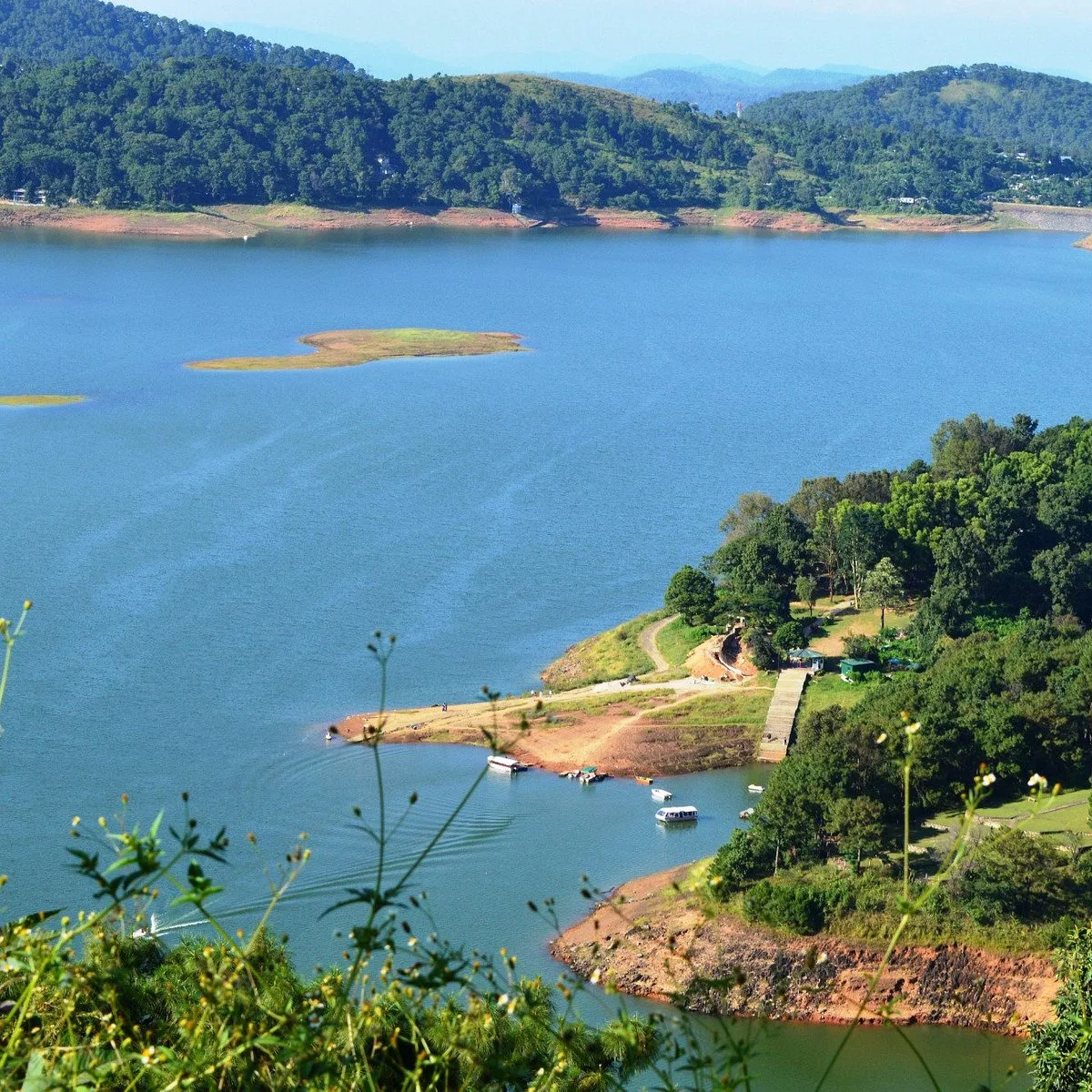
Umiam Lake (Barapani)
Umiam Lake is 15 km north of Shillong on NH6, the same road that connects Shillong to Guwahati, meaning every road traveller arriving from Guwahati passes it. The reservoir was completed in 1965 by damming the Umiam river for hydropower and covers approximately 222 square kilometres, surrounded by pine-covered Khasi Hills.
The Meghalaya Tourism-run water sports complex on the western bank offers kayaking, pedal boats, jet skis, yachting, and water skiing (Rs 20-200 depending on activity; entry to the complex Rs 50). The eastern bank viewpoints accessible from the highway are free and more scenic than the water sports area. Best treated as a 2-3 hour stop rather than a standalone day trip; the NH6 timing makes it a natural add-on to arrivals from Guwahati.
Best time: Early morning, October-May for clear reflections on the water.
Sweet Falls: Viewpoint, Not Walk-To
Sweet Falls (Ka Kshaid Weitden in Khasi) drops 96 metres from Upper Shillong, one of the tallest waterfalls near the city. It appears in most Shillong attraction lists. What those lists rarely say: the approach to the base has no maintained access path, the route is actively dangerous, and tourists are not permitted to attempt it.
Sweet Falls is a viewpoint attraction. You see it from an elevated vantage. It is dramatic at that distance (96 metres is significant), but if you arrive expecting Elephant Falls-style staircase access to the base, you will find nothing. Set expectations accordingly.
Ka Phan Nonglait Park (Lady Hydari Park)
One administrative note before visiting: Lady Hydari Park was officially renamed Ka Phan Nonglait Park in 2023, honouring the first Khasi woman who resisted British rule. Google Maps and most travel guides still show the old name. Locals use both; the entrance uses the new name.
The park has a Japanese garden design: small ponds, willows, rhododendrons, and manicured walking paths. The mini zoo on site holds Himalayan black bears, leopards, serow, deer, and reportedly 73 bird species; the deer and serow are its best feature, but the enclosures are basic and this is not a modern facility. The park itself (the gardens and ponds, not the zoo) is worth a quiet morning. Entry: Rs 10-20. Hours: 9 AM-5 PM, closed Mondays.
Cherry Blossom Festival
The Shillong Cherry Blossom Festival runs annually in mid-November at the Jawaharlal Nehru Stadium and Polo Grounds (adjacent venues, effectively the same complex). The blossoms are Prunus cerasoides, the Indian wild Himalayan cherry, which blooms in October-November, opposite to Japan’s spring season. Meghalaya is the only place in India with an autumn cherry blossom event of this scale.
The festival is significantly more than a flower show. The 2025 edition (November 14-15) headlined The Script, Jason Derulo, and Nora Fatehi on Day 1, and Diplo, Tyga, and Aqua on Day 2, alongside Khasi and Garo musicians, tribal drummers, and indigenous art collectives. It is arguably Northeast India’s largest annual ticketed cultural event. The interactive zones include zipline, craft markets, food stalls, and live performance stages running all day.
2026 dates had not been announced as of May 2026. The festival has run every year in the second or third week of November since 2016. Check shillongcherryblossom.com closer to travel dates. Book accommodation 2-3 months ahead if visiting in November; the city fills completely during the festival weekend.
Day Trips from Shillong: What to Combine and What Not To
One planning error to avoid: Do not attempt Cherrapunji, Dawki, and Mawlynnong in the same day from Shillong. The distances look manageable on a map but Meghalaya’s hill roads are slow, and rushing three distinct destinations produces a poor experience at all three.
Recommended split:
- Day 1 from Shillong: Cherrapunji: Nohkalikai Falls, Seven Sisters Falls, Mawsmai Cave (54 km, 1.5-2 hours one way)
- Day 2 from Shillong: Mawlynnong + Dawki: cleanest village and crystal river can be paired comfortably (78 km and 81 km from Shillong respectively; 2.5 hours each way)
Short trips (under 1 hour from Shillong):
- Laitlum Canyons: 21-25 km, ~1 hour
- Mawphlang Sacred Forest: ~25 km, ~1 hour
- Umiam Lake: 15 km, ~30 minutes
For the Double Decker Root Bridge hike at Nongriat: base yourself in Cherrapunji for at least one night rather than doing it as a day trip from Shillong. The hike takes 4-6 hours and the drive back to Shillong will exhaust the day.
Best Time to Visit Shillong
| Season | Months | Conditions |
|---|---|---|
| Autumn | October-November | Best overall: post-monsoon green, clearest skies, Cherry Blossom Festival in November |
| Winter | December-February | Cool to cold (5-10°C nights), clear skies, lower crowds after festival season |
| Spring | March-April | Rhododendrons in bloom, warm days, good for Mawphlang and day trips |
| Monsoon | June-September | Heavy rain, spectacular waterfalls, some road disruptions; experienced travellers only |
October-November is the strongest window. The monsoon has cleared, waterfalls are still powerful, skies are cleanest, and November brings the Cherry Blossom Festival.
Weekend vs weekday: Shillong on a Saturday or Sunday is significantly more congested than midweek. Weekend visitors from Guwahati fill the city, NH6 slows, and Elephant Falls becomes crowded. If you have flexibility, a Tuesday-Thursday visit gives a substantially better experience.
How to Get to Shillong
From Guwahati: NH6 runs ~100 km between the two cities (3-4 hours normally; allow 5-6 hours on long weekends). The road is well-maintained on the Guwahati corridor and narrows to hill road approaching Shillong. It passes Umiam Lake at the midway mark, worth a brief stop.
Transport options:
- Shared sumo/cab from Paltan Bazar area in Guwahati: Rs 200-300 per seat
- Private cab: Rs 1,500-2,500 one way
- Helicopter service: Resumed June 2025, operating twice daily Monday-Saturday between Guwahati and Shillong (check MTC Aviation for current schedules and fares)
Nearest airport: Guwahati (GAU), 100 km away. Umroi Airport (SHL) near Shillong has very limited scheduled service; do not plan flights around it.
Getting Around Shillong
Shillong has no Uber, no Ola, and no auto-rickshaws. This is not an infrastructure gap: it reflects a deliberate protection of the local transport economy under Meghalaya’s Schedule VI tribal area regulations, which give the Khasi community significant control over local livelihoods.
What exists:
- Shared yellow-top taxis (mostly Maruti 800s and Altos): fixed routes across the city, flag anywhere, pay Rs 20-40 depending on distance, the most common way locals and budget travellers move around
- Tourist taxis from Police Bazar stand: full-day hire for Rs 2,000-3,500 per day; useful for covering Shillong sights + one day trip
- Rapido bike taxis: available for solo travellers, useful for quick hops across the ridge
- Shillong CAB: a locally developed app-based cab service (Android), the homegrown alternative to Ola/Uber, works reasonably well within the city
The city’s hilly terrain means travel times between points that look close on a map can be longer than expected. Factor this when planning morning start times for viewpoints.
No Permits Required
Meghalaya requires no Inner Line Permit for Indian or foreign nationals. Standard Indian ID for residents; valid Indian visa for foreign nationals. The only exception is Shillong Peak: foreign nationals cannot enter the Air Force-controlled zone regardless of other documentation.
Explore all Meghalaya destinations and use Axomor’s trip planner to build your Shillong itinerary with day-trip distances and timings. For the full picture of what Meghalaya offers beyond the city, read our best places to visit in Meghalaya guide.
Around Shillong

Written by
Kundan GuptaWrites from Assam. Checks fares and fees in person before publishing.
Kundan Gupta runs Axomor and edits its Northeast India coverage. He is responsible for the accuracy of the guides published here, including checking permit rules, fees and travel logistics against primary sources before they go live.
Ready to plan this trip?
Use Axomor's free trip planner to build your custom Northeast India itinerary, with distances, permits, and the best time to visit each spot.