

The best places to visit in Meghalaya span waterfalls that plunge into the earth’s deepest gorges, rivers so clear you can count the pebbles below, and living bridges woven from tree roots over hundreds of years. Meghalaya, the Abode of Clouds, is unlike anywhere else in India. If you’re planning a trip to Northeast India, Meghalaya deserves the most time on your itinerary.
Axomor has catalogued over 60 places across Meghalaya’s hills, valleys, and tribal heartlands. This guide covers what’s actually worth your time, from the famous to the barely-known.
Why Meghalaya Should Be at the Top of Your List
Meghalaya is the wettest place on Earth, and that’s what drives everything great about it. All that rainfall feeds some of India’s most spectacular landscapes: multi-tiered waterfalls, underground cave systems, crystal rivers fed by pristine watersheds, and dense subtropical forests. The Khasi, Garo, and Jaintia tribes have shaped a culture that is matrilineal, warm, and rooted in the land.
Unlike more crowded hill stations, many of Meghalaya’s best spots require a little effort: a winding drive on mountain roads, a hike through jungle. Which means you often have them nearly to yourself outside peak season.
The Best Places to Visit in Meghalaya
1. Nohkalikai Falls: India’s Tallest Plunge Waterfall
Nohkalikai Falls drops 340 metres in a single plunge into a pool of striking turquoise-green water. It’s located near Cherrapunji (Sohra), the wettest place on Earth, and during and after the monsoon the falls are at their most powerful. A wall of white water with a constant roar you feel in your chest.
- Best time: July-September (full monsoon flow) or October-November (post-monsoon, still strong)
- Entry: Rs 20 for Indians
- Getting there: 5 km from Cherrapunji town, well-signposted
2. Double Decker Living Root Bridge: Nongriat
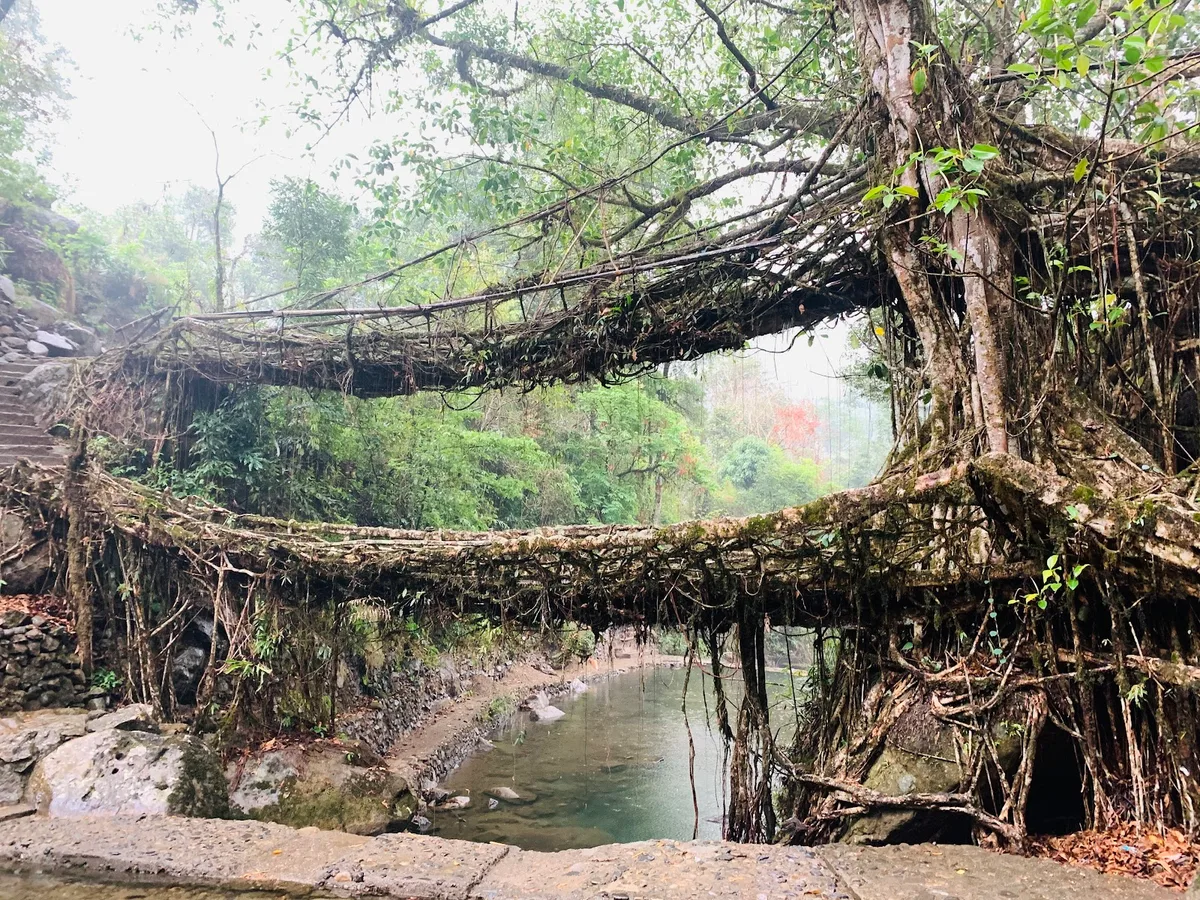
The Double Decker Living Root Bridge in Nongriat is the most famous structure in Meghalaya, and it earns the hype. Two bridges stacked atop each other, grown from the aerial roots of Ficus elastica trees over 150-200 years, still strengthening with every passing season.
The hike down takes 45-60 minutes (3,000+ steps) and the same coming back up. Go early. By 10am the trail fills up. Spend an hour at the bridge and take a dip in the natural pools below.
- Best time: October to May (monsoon makes the trail slippery and dangerous)
- Entry: Rs 100 per person + Rs 50 for the village
- Base: Stay overnight in Nongriat, there are 3-4 simple guesthouses
3. Dawki and Umngot River: The Clearest River in India
Dawki sits on the Bangladesh border, and the Umngot River here is so clear that boats appear to float in mid-air. This is not a photo filter. On a calm day, the water is genuinely invisible from certain angles.
Hire a boat (Rs 500-800 per boat, 45 minutes) and drift downriver. The best light is between 8-10am before the river fills with tourist boats.
- Best time: November to May
- Getting there: 82 km from Shillong, 3 hours by road (shared cab or rented car)
4. Mawlynnong: Asia’s Cleanest Village
Mawlynnong has held the title of Asia’s Cleanest Village since 2003. Spotless paths lined with bamboo dustbins, immaculately maintained homes and gardens, and a community that genuinely takes pride in every corner of it.
Climb the bamboo tree house for a view over the treetops toward Bangladesh. It’s a photogenic place, but not a staged Instagram set. The cleanliness is real.
- Entry: Rs 20, free for children
- Combined with: Dawki (35 km away), both work well in one day from Shillong
5. Cherrapunji (Sohra): The Wetland Heartland
Cherrapunji (officially Sohra) is the base for much of Meghalaya’s best sightseeing: Nohkalikai Falls, the Seven Sisters Falls, Mawsmai Cave, Arwah Cave, and the trail to Nongriat. Plan at least two nights here.
The town itself sits on a misty plateau at 1,300m, with dramatic views into the Bangladesh plains below on clear days.
- Hub for: Nohkalikai Falls, Nongriat/Root Bridge, Mawsmai Cave, Wei Sawdong Falls
- How to reach: 54 km from Shillong, 1.5 hours
6. Shillong: The Gateway City
Shillong is Meghalaya’s capital and your most likely entry point (nearest airport: Umroi, 35 km; or drive 3 hours from Guwahati). The city is famously musical. Shillong has produced some of India’s best guitarists and rock bands, and live music on Police Bazar evenings is a real pleasure.
For sightseeing: Ward’s Lake, Don Bosco Museum, Elephant Falls, and the Shillong Peak viewpoint.
- How to reach: 3 hours drive from Guwahati; fly to Umroi (SHL) airport
7. Jowai and Krang Suri Falls: Jaintia Hills’ Blue Jewel
Krang Suri Falls, near Jowai in the Jaintia Hills, has possibly the most electric blue-green water of any waterfall in Northeast India. It’s less visited than Nohkalikai but arguably more beautiful up close: a multi-tiered cascade into a deep pool you can swim in.
- Entry: Rs 50
- Best time: October-May
- Distance: 68 km from Shillong (1.5 hours)
Best Time to Visit Meghalaya
| Season | Months | What to Expect |
|---|---|---|
| Post-monsoon | Oct-Nov | Waterfalls at peak, skies clearing, trails manageable |
| Winter | Nov-Feb | Dry, cool (5-15 C at altitude), best for Dawki and Mawlynnong |
| Spring | Mar-Apr | Warm, rhododendrons in bloom, shorter crowds |
| Monsoon | Jun-Sep | Intense rainfall, road closures, Nohkalikai at max - for adventurous travellers |
Best overall: October to February for most visitors. March-April for root bridge hiking (dry trails, moderate heat).
How to Get to Meghalaya
By Air: Fly into Guwahati (GAU), the main regional hub, well connected from Delhi, Kolkata, Bangalore, and Hyderabad. From Guwahati, Shillong is a 3-hour drive (shared cabs from Paltan Bazar, Rs 300-400). Umroi Airport (SHL) near Shillong has limited flights.
By Rail: Guwahati is the nearest major railway hub. Overnight trains from Kolkata (12-14 hours) and Delhi (27-36 hours) are comfortable and economical.
By Road: NH6 connects Guwahati to Shillong through scenic hills, about 100 km total. A self-drive or hired car is recommended for getting around within Meghalaya. Shared cabs connect major towns but run infrequently.
No Permits Required
Unlike Arunachal Pradesh, Meghalaya requires no Inner Line Permit (ILP) for Indian or foreign nationals. Standard Indian ID is enough. Foreign nationals need a valid Indian visa only.
How to Plan Your Meghalaya Trip
A 5-day itinerary covers the highlights:
- Day 1: Arrive Guwahati, drive to Shillong
- Day 2: Shillong city - Ward’s Lake, Elephant Falls, evening on Police Bazar
- Day 3: Shillong to Cherrapunji - Nohkalikai Falls, Seven Sisters Falls, Mawsmai Cave
- Day 4: Cherrapunji, hike to Double Decker Root Bridge, Nongriat overnight
- Day 5: Return to Shillong via Dawki and Mawlynnong
For the full hike guide and details on other root bridges across the state, read our living root bridges Meghalaya guide.
Use Axomor’s trip planner to customise distances, timings, and permits for your exact route. Explore all Meghalaya destinations.
Specific journeys and seasons

Written by
Kundan GuptaWrites from Assam. Checks fares and fees in person before publishing.
Kundan Gupta runs Axomor and edits its Northeast India coverage. He is responsible for the accuracy of the guides published here, including checking permit rules, fees and travel logistics against primary sources before they go live.
Ready to plan this trip?
Use Axomor's free trip planner to build your custom Northeast India itinerary, with distances, permits, and the best time to visit each spot.