
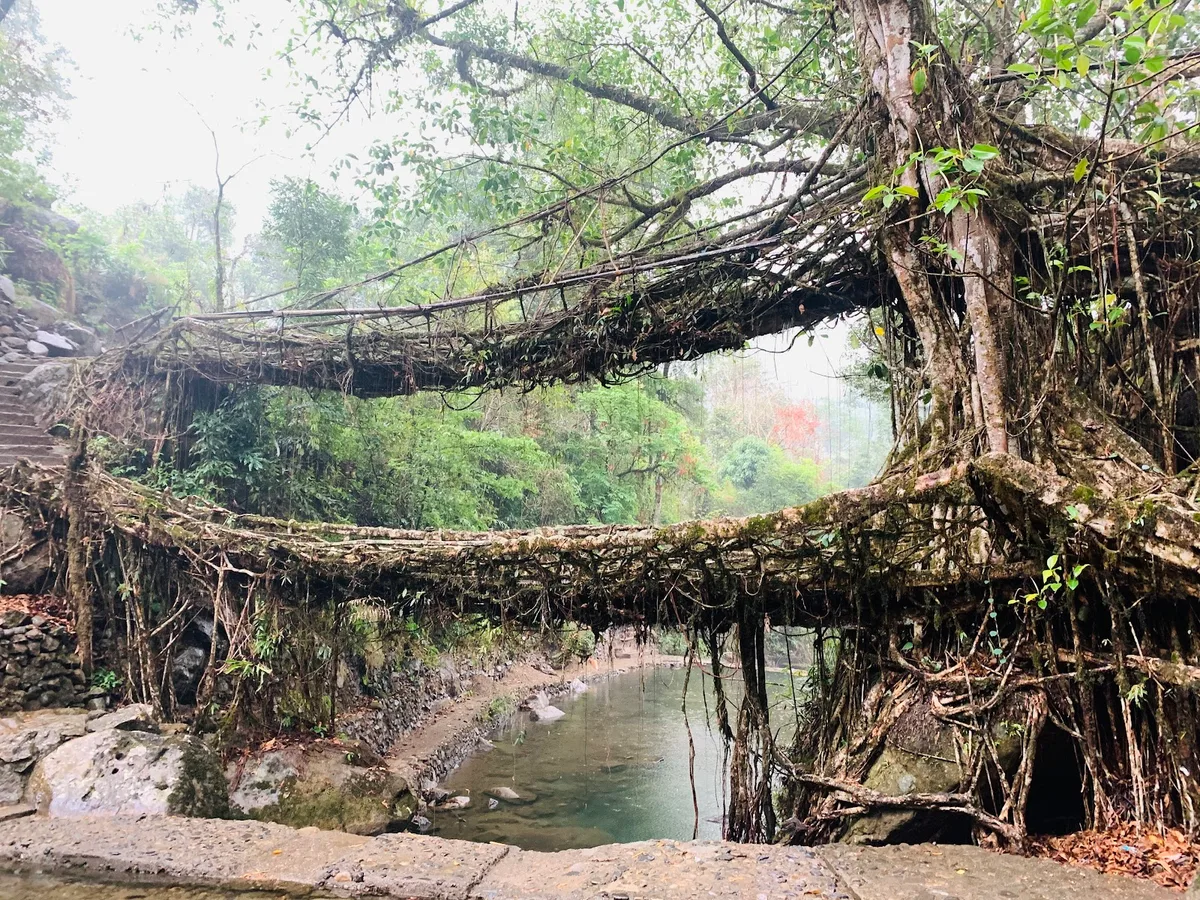
India nominated the living root bridges Meghalaya harbours for UNESCO World Heritage status in March 2026. It took this long because the structures were hiding in plain sight: not ruins, not temples, but living bridges grown from the aerial roots of rubber fig trees, still strengthening with each passing year.
Meghalaya has over 240 of them. Most tourists see one. The double-decker at Nongriat gets all the attention, and it deserves it, but it is one small part of a tradition practiced across 70+ villages in the southern hills.
Axomor has catalogued the places that matter most, including the Double Decker Living Root Bridge and the trail from Tyrna that leads to it. This guide covers the Nongriat hike in practical detail, the biology behind the living root bridges of Meghalaya, other bridges worth visiting, what to carry, and which season to go.
What Makes a Living Root Bridge
These are grown, not built. The War-Khasi and War-Jaintia communities who live in the deep ravines of southern Meghalaya train the aerial roots of the Ficus elastica tree (Indian rubber fig, known locally as Dieng Jri) across river gaps using hollowed betel nut palm trunks as scaffolding channels. The roots grow through the guide, cross the span, and eventually fuse through a process called anastomosis, where touching roots graft themselves together. The scaffold rots away. What remains gets stronger over decades.
A functional bridge takes 15-30 years to form. The oldest are estimated at 500 years. Unlike any engineered structure, they gain load-bearing capacity with age. The most mature examples can hold 50+ people simultaneously.
Around 20 elders across Meghalaya hold the full knowledge of bridge cultivation. The Heritage Committee, backed by UNDP, has adopted 30 bridges for formal conservation and is actively growing new ones. New roots are trained each monsoon season, when the trees are most active. Youth apprentice under elders during those months.
The Double Decker at Nongriat
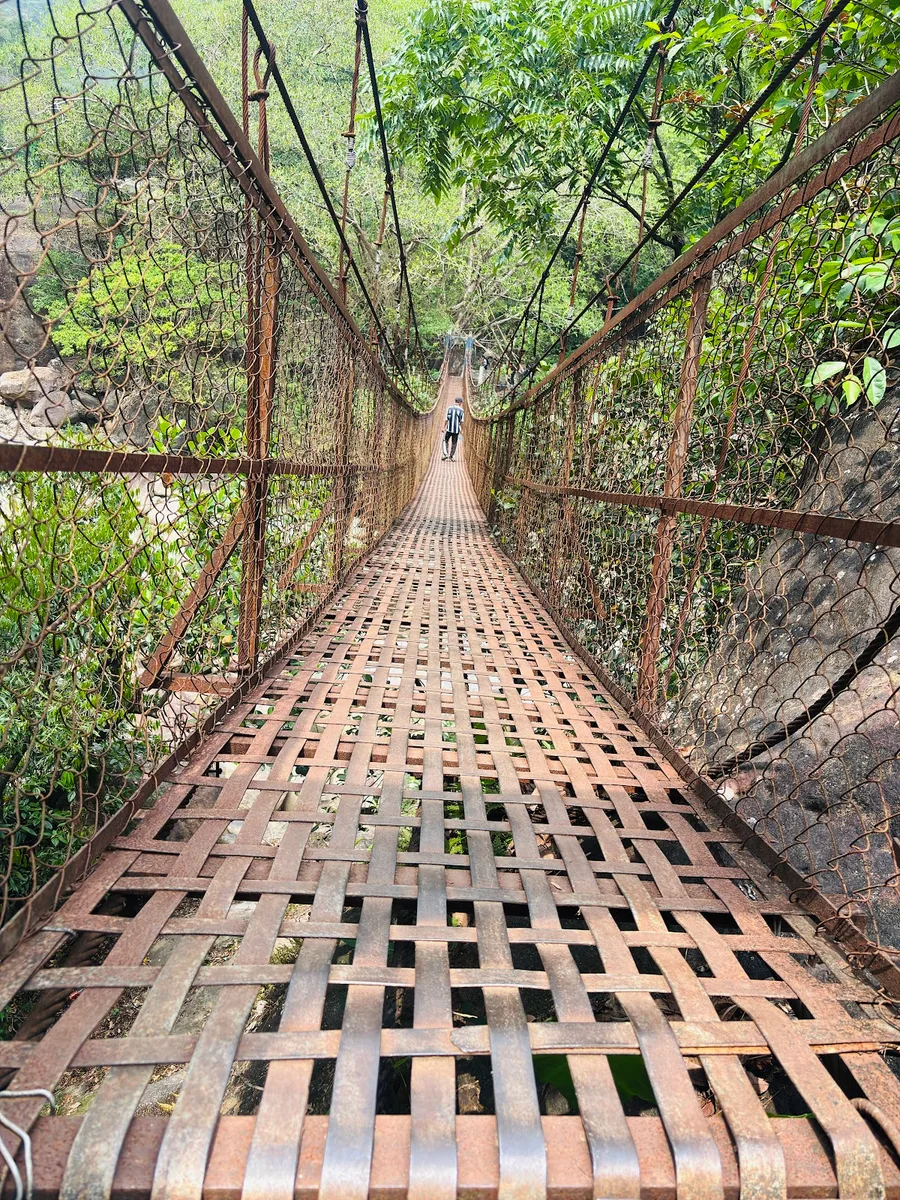
The formal name is the Umshiang Double Decker Living Root Bridge, named after the river it crosses. There are two reasons it became famous: the visual drama of two bridges stacked and grown from the same trees, and a practical one that most travel articles skip.
The lower bridge was built first. Monsoon floods repeatedly submerged it. Rather than start over, the War-Khasi cultivated a second tier above the flood line over decades. The result is functional engineering that happens to look extraordinary.
A natural pool sits below both tiers. Swimming is now prohibited. Overtourism caused visible damage to the banks and the bridge itself, and locals enforce the restriction. Older guides describe it as a highlight; that option is no longer on the table.
A maximum of 5 people are allowed on the bridge at once. Between 10am and 2pm, there is a near-constant queue. Go early or stay overnight in Nongriat and you will have it to yourself in the morning.
Entry fee: approximately Rs 20-50 per person (community-set, can change; verify on arrival). A separate small fee applies at the Long Bridge you pass mid-trail. Parking at Tyrna: Rs 50-100.
The Hike from Tyrna: What to Expect
The trailhead is Tyrna village, about 12-18 km by road from Cherrapunji (Sohra). Some maps mark the starting point as Mawmluh village, an adjacent settlement at the same stairhead. If your driver knows Mawmluh but not Tyrna, they are heading to the same place.
The trail is a stone staircase, hand-laid, descending roughly 450 metres into the ravine through subtropical jungle. Step count is somewhere between 3,000 and 3,500 one way, depending on which section you start counting from. No one actually knows the precise figure, and experienced trekkers who have done the route multiple times cite different numbers. Consider the uncertainty a fair warning: bring more energy than you think you need.
The descent is deceptive. The steps feel manageable going down. The return climb is where people run out of water and sit.
Waypoints and approximate times (one way, moderate pace):
- Tyrna to Long Bridge (single-decker root bridge): 30 minutes
- Long Bridge to Nongriat village: 45 minutes
- Nongriat to Rainbow Falls: 1 hour 20 minutes (optional extension, mostly uphill)
Return climb (Nongriat to Tyrna): 2-3 hours depending on pace.
The trail crosses several suspension bridges of varying stability. One metal bridge is known to be periodically under repair and replaced by a temporary bamboo ladder. This is routine here.
Total round trip to the double-decker and back: 4-5 hours without accounting for time at the bridge. Doing it as a day trip is possible. Most people who have done it recommend staying overnight.
Guides are not legally required. Some trail junctions are unmarked, and a local guide knows the sacred forest groves (law kyntang) along the route where entry is forbidden. There is no tourist signage explaining these. Hire a guide in Tyrna or through your homestay.
What to Carry
Shoes with grip are not optional. The stone steps get slippery after any rain, and this is Cherrapunji district.
Water: at least 2 litres per person. Small shops at Tyrna and mid-trail sell water and Maggi, but at marked-up prices and without guaranteed stock.
Cash only. UPI is unreliable in the ravine. Bring enough for entry fees, meals, accommodation, and incidentals. No ATM exists in Nongriat.
Raincoat or poncho. Regardless of season.
Torch or charged phone. No lighting on the trail after dark.
Bamboo trekking pole. Available to hire at Tyrna for Rs 20, returnable when you exit. Worth it on the return climb.
Pack light. Every kilogram counts on the way back up.
Other Living Root Bridges in Meghalaya
Most people visit one root bridge and leave Meghalaya thinking that was it. It was not.
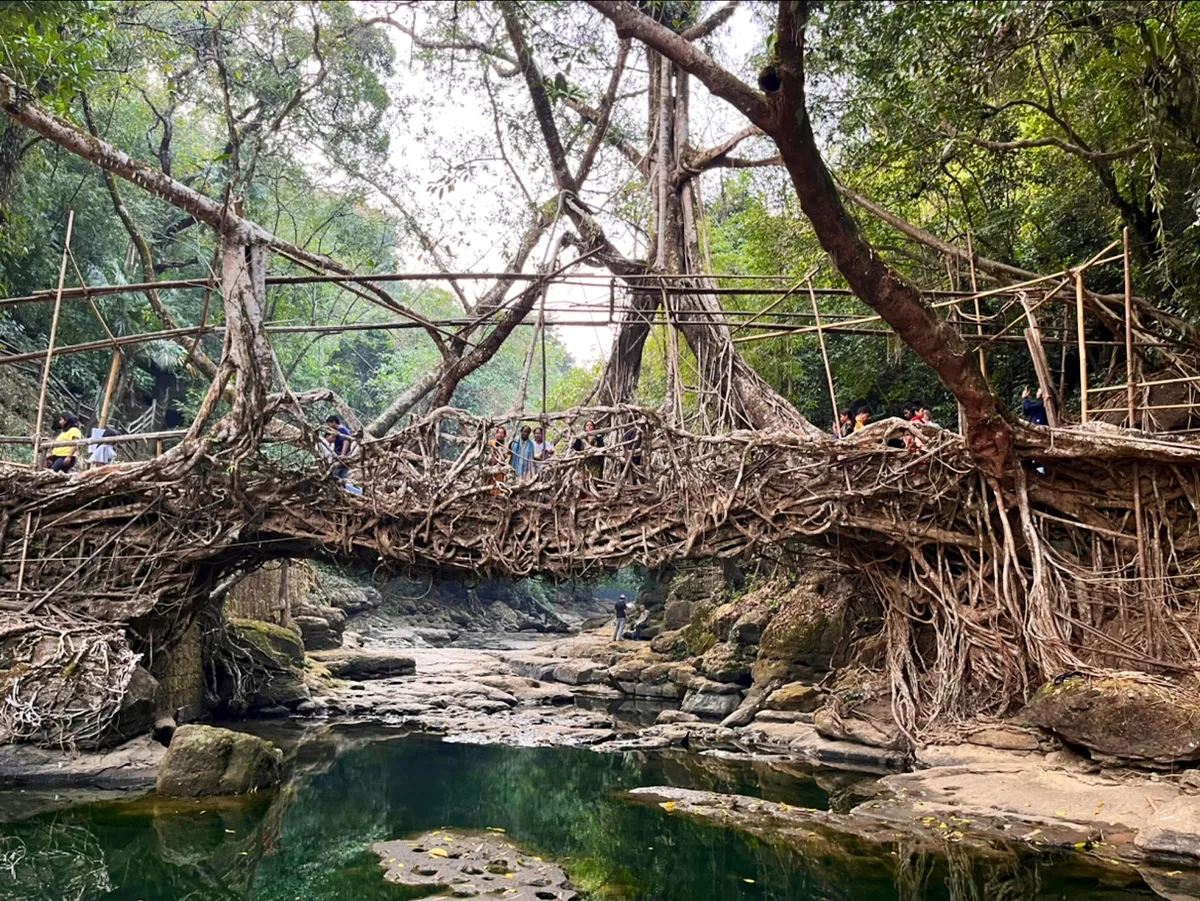
Riwai (Jingmaham) Bridge, near Mawlynnong: The most accessible root bridge in the state. A 15-20 minute walk through forest from the road at Mawlynnong village. Single span, approximately 300 years old, crosses a stream between betel nut trunks. No long hike, no guide required. This is manageable as an add-on to a Mawlynnong day trip from Shillong.
Rangthylliang Bridge, near Pynursla: The longest documented root bridge in Meghalaya at over 50 metres. Located near Pynursla town, accessed from Mawkyrnot or Rangthylliang villages. Largely unknown to mainstream tourism. A second double-decker structure nearby has barely been photographed. If you want a root bridge without a crowd, this is the most accessible alternative.
West Jaintia Hills (Padu and Nongbareh villages): Two more double-decker bridges exist here, almost never visited, no tourism infrastructure. Remote but real. You need a local contact or guide to reach them.
India’s UNESCO nomination document covers 75+ villages as part of what it calls the Jingkieng Jri living root bridge cultural landscape. There are 240+ documented structures. Nongriat holds 1 of them.
When to Go
October to April is the safe window. The stone steps dry out, the trail is manageable, and the jungle remains green.
| Months | Conditions |
|---|---|
| Oct-Nov | Green from monsoon, waterfalls running strong, trails passable |
| Dec-Feb | Coolest and driest, ideal for the climb |
| Mar-Apr | Warmer, less crowded, morning light through the ravine is good |
| Jun-Sep | Avoid unless experienced. Stone steps become dangerous, leeches are prolific, flash floods and landslides are documented risks. No official trail closure, but this is not casual territory. |
Monsoon season is when bridge root growth is most active, so locals actually prefer it for cultivation. The bridges themselves are fine in monsoon. They have handled it for 500 years. You are the less robust element.
One note on Sundays: some sources say the village restricts access on Sundays (the Khasi Christian day of rest). This is not confirmed and varies by year. Call a Nongriat homestay before planning a Sunday visit.
Getting There
From Cherrapunji (Sohra): Tyrna is roughly 12-18 km by road, about 25-40 minutes. A private taxi from Sohra market costs Rs 200-400. Shared cabs toward Tyrna and Mawmluh do run but without fixed schedules; you wait until the cab fills. Parking at Tyrna for private vehicles: Rs 50-100.
From Shillong: Cherrapunji is 54 km from Shillong, about 1.5 hours. Shared sumos leave from Police Bazar for Rs 70-80 per seat. From Sohra, proceed to Tyrna as above.
Where to Stay in Nongriat
Nongriat now has 8-10 guesthouses and homestays, up from 2 a decade ago. None of them are hotels. Expect basic facilities: ceiling fans, shared bathrooms common, simple home-cooked meals. That is the experience.
Dorm beds: Rs 300-400 per person. Private rooms: Rs 500-900 per person. Meals: Rs 50-130. Budget Rs 500-1,500 per person per night including food.
Electricity in Nongriat is unreliable after storms. Mobile connectivity is poor to non-existent in the ravine. Carry a power bank and enough cash.
Serene Homestay and Chally’s Guesthouse are the longest-established options and tend to fill up on weekends. Contact them directly when planning.
Staying overnight is worth doing for reasons beyond convenience: early morning access to the bridge before tour groups arrive, time to walk to Rainbow Falls, and the uncommon experience of spending a night in a ravine village with no reliable electricity or signal.
Plan Your Meghalaya Trip with Axomor
The living root bridges fit naturally into a Meghalaya loop. From Shillong, a 4-5 day route covers Cherrapunji, Nongriat, Dawki, and Mawlynnong, with the Nongriat hike as the centrepiece activity.
For the full picture of what Meghalaya offers, read our Best Places to Visit in Meghalaya guide, and the Best Time to Visit Meghalaya post for month-by-month planning. Explore all Meghalaya destinations on Axomor.
The living root bridges of Meghalaya are growing more famous at the same time the knowledge to build them is disappearing. Around 20 elders hold the full construction tradition. The UNESCO nomination is a recognition of urgency as much as beauty. Go with that context. And go early, before the trail fills up.

Written by
Kundan GuptaWrites from Assam. Checks fares and fees in person before publishing.
Kundan Gupta runs Axomor and edits its Northeast India coverage. He is responsible for the accuracy of the guides published here, including checking permit rules, fees and travel logistics against primary sources before they go live.
Ready to plan this trip?
Use Axomor's free trip planner to build your custom Northeast India itinerary, with distances, permits, and the best time to visit each spot.