
Gangtok sits at around 1,650 metres on a single long ridge above the Ranipul valley, and almost every visitor to Sikkim passes through it. The city earns its position as the hub not because it has Sikkim’s most spectacular scenery, but because it has the permits office, the taxi stand, and the logistics infrastructure for everything else in the state. The tourist places in Gangtok often surprise visitors: a monastery at the centre of one of Buddhism’s most dramatic succession disputes, one of the largest Tibetan manuscript libraries in the world, and a pedestrian street that turns genuinely lively in the evenings.
This guide covers the tourist places in Gangtok city and the day trips that make Gangtok the natural anchor for a Sikkim itinerary.
Tourist Places in Gangtok
MG Marg: The City’s Social Core
MG Marg is Gangtok’s kilometre-long pedestrianised main street, all-day and permanently vehicle-free. That is worth stressing because a common misconception paints it as a pedestrian zone only in the evenings. No vehicles are permitted here at any hour, any day.
One planning detail almost every guide omits: shops on MG Marg close on Tuesdays. If you arrive on a Monday evening and plan to shop or explore on Tuesday morning, you will find shuttered storefronts. Restaurants and cafes are less consistent about this, but most retail closes.
The street is best between 5 PM and 8 PM when local office workers and families come out, string lights switch on, and street food vendors set up properly. Look for momos (steamed dumplings), thukpa (noodle soup), and tongba, millet beer served warm in a bamboo mug with a straw, a Tibetan-origin drink common in Sikkim and Darjeeling. Local Sikkim beer (Dansberg) is good and inexpensive.
Sikkim enforces one of India’s strictest public smoking bans. Smoking on MG Marg and in any public space carries an on-the-spot fine; this is not theoretical.
Since 2025, bars and pubs on and near MG Marg must close by 11 PM under updated Sikkim government regulations, and the legal drinking age was raised to 21. Worth knowing if you are travelling with younger members of the group.
Rumtek Monastery: Kagyu Buddhism’s Unresolved Succession
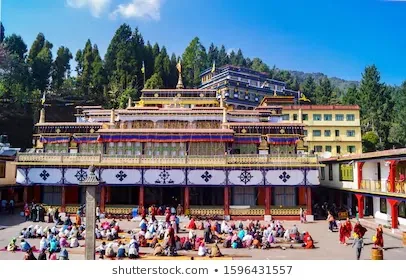
Rumtek Monastery is 23 km from Gangtok, about an hour by road through terraced paddy fields and Sikkimese villages. Entry is Rs 10. Hours: 9 AM-6 PM.
The monastery was built in the 1960s by the 16th Karmapa, Rangjung Rigpe Dorje, as his seat-in-exile after fleeing Tibet in 1959. It became one of the most important centres of the Kagyu school of Tibetan Buddhism. What happened after the 16th Karmapa died in 1981 turned Rumtek into the site of one of the most complicated religious-legal disputes in modern Indian history.
Two rival candidates emerged as the 17th Karmapa: Ogyen Trinley Dorje, recognised by the Dalai Lama (and, controversially, by the Chinese government); and Trinley Thaye Dorje, recognised by the Shamar Rinpoche. In 1992, armed clashes between rival monk factions occurred at Rumtek itself. CRPF and Sikkim police were deployed. Indian courts (the Sikkim District Court, the Sikkim High Court, and ultimately the Supreme Court) all ruled in 2002-2004 that the Karmapa Charitable Trust, supporting Trinley Thaye Dorje’s claim, has legal stewardship of the monastery. As of 2025, pending cases mean neither Karmapa has been enthroned at Rumtek. Ogyen Trinley Dorje cannot enter Sikkim. The monastery functions and is spiritually active, but it is politically frozen in a dispute that has lasted over four decades.
Most guides describe Rumtek as “Sikkim’s most important monastery.” That is accurate but misses the story.
What to see: The main prayer hall on the ground floor has hand-painted murals, silk thangkas, and the 16th Karmapa’s preserved residence on the first floor. The Golden Stupa (1984) opposite the Nalanda Institute contains his relics. The Karma Sri Nalanda Institute of Buddhist Studies is the attached monastic college. The Black Hat (studded with gold, diamonds, and rubies) is shown only during special ceremonies.
Shared jeeps depart from near Hotel Hungry Jack in Gangtok (10 AM-2 PM window, Rs 100-200 per person). Private taxi from Gangtok: approximately Rs 800-1,200 one way.
Enchey Monastery: The Ridge Monastery with the Masked Dance
Enchey Monastery sits on a forested ridge 3 km north of MG Marg at around 1,980 metres, noticeably above the city, with sweeping views over the valley. Entry is free. Hours: 9 AM-6 PM.
Built in 1909, the site was originally a meditation retreat of the 19th-century tantric master Druptob Karpo (said to be able to fly), and the small chapel he used still stands adjacent to the newer building. This is a functioning Nyingma monastery with resident monks; it is not primarily a tourist attraction and is better for it.
The Detor Cham (masked dance festival) is performed on the 18th and 19th day of the 12th Tibetan lunar month, typically falling in January or February. Monks perform in elaborately decorated costumes and masks representing protective deities. This is one of the more accessible monastic festivals in Sikkim, held in an open courtyard with room for visitors.
Best visited before 10 AM when it is quiet. The forest path up from below the ridge takes 15-20 minutes on foot; taxis go directly.
Do-Drul Chorten: The Liberation Stupa
Do-Drul Chorten is one of the most important Nyingma stupas in Sikkim, built in 1945 by Trulshik Rinpoche at the invitation of the Chogyal of Sikkim. The site had an inauspicious reputation and the stupa was erected specifically to consecrate it. Free entry.
The name translates roughly as “the stupa that liberates upon sight,” a Vajrayana concept, not decorative naming. Inside the central chamber is a complete Dorje Phurba mandala set and the Kangyur (the complete Buddhist canon in text form). Exactly 108 prayer wheels surround the stupa’s base, each engraved with Om Mani Padme Hum; spin them clockwise as you walk the circumambulation path.
This is the seat of Kyabje Dodrupchen Rinpoche, considered one of the most accomplished living Nyingma lamas. A monastic college accommodating around 700 monks operates here. The compound has a different atmosphere from the more visited sites: quieter, more actively devotional.
Namgyal Institute of Tibetology: 60,000 Manuscripts
The Namgyal Institute of Tibetology (NIT) in Deorali, 3 km from MG Marg, is the kind of place that appears as a footnote in most “Top 10 Gangtok” lists and deserves substantially more than that.
Founded in 1958 under the patronage of the last Chogyal of Sikkim and the Dalai Lama, predating Sikkim’s merger with India, the NIT holds one of the world’s largest collections of Tibetan texts outside Tibet: over 60,000 volumes of Tibetan manuscripts and books. Among them, one manuscript written entirely in gold. The museum contains over 200 Buddhist statues, thangkas, ritual masks, and silk paintings. The institute publishes the academic journal Bulletin of Tibetology and hosts international scholars. This is a functioning research institution that has been active for over 65 years.
For any visitor with an interest in Tibetan Buddhism, Himalayan history, or Buddhist art, the NIT warrants an hour or two that most people give to the ropeway.
Hours: Monday-Saturday, 10 AM-4:30 PM. Closed Sundays, second Saturdays, and public holidays. Entry: Rs 25 per person. The lower ropeway station (Deorali) is immediately adjacent, so logical to combine.
Gangtok Ropeway
The Gangtok ropeway has been running since December 2003, one of the earliest urban cable cars in Northeast India. It connects three stations: Deorali Bazar → Namnang → Tashiling (Sikkim Legislative Assembly area), covering about 935 metres total.
What distinguishes it from purely tourist cable cars is that it is also a working commuter link between a residential-commercial area and the government quarter. Sharing a cabin with a civil servant heading to the legislature at 9:30 AM is a genuinely different experience from a resort gondola.
Fares (from January 2025, plus 5% GST): Adult round trip approximately Rs 169; child approximately Rs 89; under 3 free. Hours: 9:30 AM-6 PM daily. May close during heavy monsoon rain or thick fog.
Views on a clear day include the Kanchenjunga range and a good aerial read of how Gangtok drapes across its ridge system. Best October-May; unpredictable in monsoon.
Banjhakri Falls and Energy Park
Seven kilometres from the city centre (15-20 minutes by taxi), Banjhakri Falls is a 2-acre themed cultural park built around a 30-metre waterfall. Entry: Rs 100 per person. Hours: 8 AM-6 PM daily.
The park is themed around Ban Jhakri, the mythical forest shaman of Nepali and Kirati folklore, with large ethnic sculptures of Ban Jhakri, his consort Lyam Lymay, and Lepcha ancestor figures throughout. The dragon-shaped footbridge and manicured garden around the waterfall give it a fantastical quality.
Most descriptions call it just “a waterfall” and miss the cultural angle entirely. The park explicitly represents pre-Hindu Himalayan shamanic tradition in sculptural form, unusual and worth seeing as a folklore archive as much as a natural attraction.
Ganesh Tok and Tashi Viewpoint
Ganesh Tok is a small ridge-top temple 6 km from MG Marg, physically tiny (about four people fit inside at once) but positioned for a bird’s-eye view of the entire Gangtok cityscape spread across the ridges, backed by the Kanchenjunga range on clear days. Free entry, donation box at the shrine.
Tashi Viewpoint, 2 km further at ~8 km from MG Marg, adds the Kanchenjunga range more prominently, with distant views of Phodong and Labrang monasteries on the opposing hillsides. Free entry; Rs 20 parking.
Hanuman Tok, 3 km beyond Tashi Viewpoint, is an army-managed temple at around 2,200 metres with similar views and a quieter atmosphere than the two lower viewpoints. The drive to all three takes under an hour total from Gangtok; combine them in a single morning circuit.
Practical note: All three are cloud-dependent. October-May mornings give the clearest views. By noon in any season, valley cloud often builds. By monsoon afternoons, you may see nothing.
Day Trips from Gangtok
Tsomgo Lake and Nathu La Pass
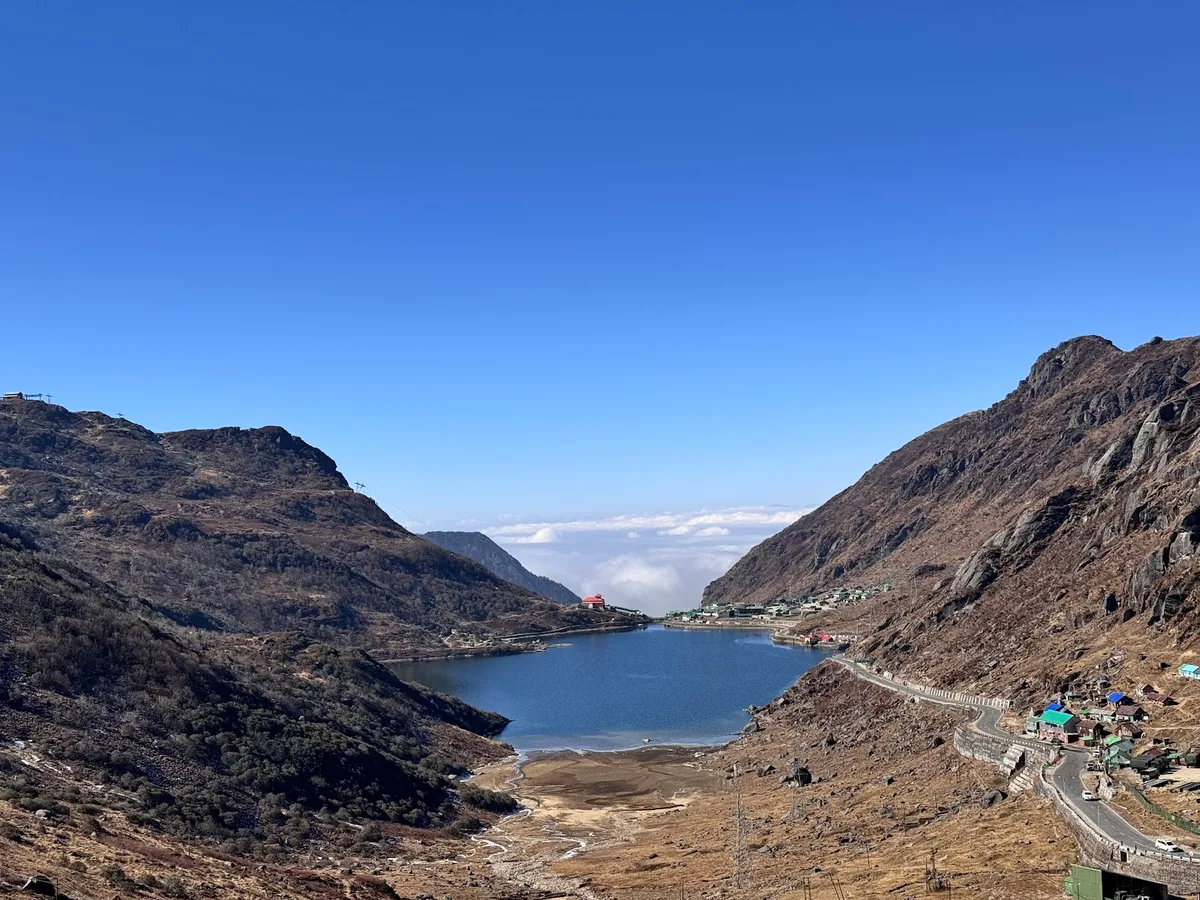
Tsomgo Lake (40 km, 1.5 hours) and Nathu La Pass (54 km, 2 hours) are covered in detail in our Sikkim travel guide. Key permit facts worth repeating for Gangtok-specific planning:
Nathu La is closed Monday and Tuesday, and entirely from November to April due to snowfall. This is a firm constraint. If your Gangtok days fall on a Monday-Tuesday or in winter, Nathu La is not an option regardless of permit.
Foreign nationals cannot visit Nathu La under any circumstances. Tsomgo Lake is accessible to foreigners with a PAP.
Shared jeep tours from Gangtok combine Tsomgo + Baba Mandir (+ Nathu La on open days) for Rs 800-1,000 per person. Arrange through your hotel or any Gangtok travel agent the day before.
The daily permit cap for Nathu La is approximately 50-80 visitors. Book at least one day in advance; the slot fills quickly in October-November peak season.
Seven Sisters Waterfalls: A Monsoon-Only Spectacle
Seven Sisters Waterfalls is on the Gangtok-Lachung highway (NH10), approximately 32 km northwest of Gangtok, toward North Sikkim. This is entirely separate from the Tsomgo/Nathu La route, which goes southeast. Guides that place it near Tsomgo are incorrect.
The falls are seven separate cascade streams emerging from a single cliff face. The critical fact: all seven are only visible during monsoon (July-September). In the dry season, two or three streams remain. Most of the dramatic multi-cascade photos circulating online are monsoon shots. If you visit between November and April, expectations should be calibrated accordingly.
No entry fee. Roadside viewpoint, 10-15 minutes from the road.
Best Time to Visit Gangtok
| Season | Months | Conditions |
|---|---|---|
| Autumn | October-November | Best overall: clear skies, Kanchenjunga visible, all routes open, peak festival season |
| Winter | December-February | Cold nights (near 0°C), clear mornings, Enchey Monastery Chaam dance, Nathu La closed |
| Spring | March-May | Orchid and rhododendron bloom, Flower Festival in May, pleasant temperatures |
| Monsoon | June-September | Fog, rain, landslides possible on mountain roads; Seven Sisters at maximum flow |
October-November is the strongest window for first-time visitors: the permit routes are open, the skies are the clearest of the year, and the Kanchenjunga views from the city’s ridges are at their best.
For the Orchid Flower Festival: May. Held for the entire month at the Flower Exhibition Centre, covering 600+ orchid species across Sikkim’s dense orchid biodiversity.
For Enchey Monastery Chaam Dance: January-February (18th-19th day of the 12th Tibetan lunar month; exact date shifts annually, confirm closer to travel).
How to Get to Gangtok
By Air: Bagdogra Airport (IXB) is the correct arrival point, 124 km from Gangtok (4-5 hours by road). It has regular flights from Delhi, Kolkata, Mumbai, and Bangalore.
Pakyong Airport (PYG), 31 km from Gangtok, has had no reliable scheduled commercial service since SpiceJet suspended routes in 2022-23. It remains non-operational for regular passenger flights as of 2025. Any guide recommending Pakyong as an option is working from outdated information.
By Rail: New Jalpaiguri (NJP) station is 163 km from Gangtok. Direct overnight trains from Kolkata, and connections from most major Indian cities. Shared jeeps from NJP to Gangtok run throughout the day for Rs 300-400 per person, taking 4-5 hours on the Teesta valley highway.
From Bagdogra or NJP: Shared jeeps depart from the pre-paid taxi stand at both points. The NJP and Bagdogra shared jeep prices are similar; choose based on which is closer to your arrival point.
Getting Around Gangtok
Gangtok has no internal public transport that is useful to visitors. Taxis and shared jeeps are how you move. Key stands:
- Deorali Taxi Stand (~2 km below MG Marg): long-distance routes to NJP, Siliguri, Darjeeling, and Kalimpong
- Near Vajra Cinema Hall (MG Marg area): North and East Sikkim routes, including Lachen, Lachung, Yumthang, Tsomgo/Nathu La day tours
- SNT Bus Stand (Paljor Stadium Road): Government buses, cheapest option for Pelling, Ravangla, and Namchi
Shared jeeps fill and go with no fixed schedule. Arrive at the taxi stand by 7 AM for morning departures. Last departures typically by 3-3:30 PM.
Permits: What You Need for Gangtok
No permit required for Gangtok itself (Indian or foreign nationals). The city, its monasteries, and MG Marg need nothing beyond a standard ID.
PAP (Protected Area Permit) required for: Tsomgo Lake, Nathu La, and all North Sikkim destinations (Lachen, Lachung, Yumthang). Arrange through your hotel or any registered agent in Gangtok. Bring two passport-size photos and a government-issued photo ID. Aadhar Card is not accepted for PAP applications; use Passport, Voter ID, or Driving License.
Sikkim introduced a digital permit system in 2025 that allows online document submission and real-time tracking. Ask your operator about online processing, which avoids the half-day wait at the permit office.
How to Plan Your Gangtok Days
Two-day Gangtok city coverage:
- Morning Day 1: Rumtek Monastery (full 2-3 hours for the monastery and Golden Stupa)
- Afternoon Day 1: Do-Drul Chorten, then walk to the NIT (adjacent to Deorali ropeway)
- Evening Day 1: MG Marg from 5 PM; tongba at any of the ridge-facing cafes
- Morning Day 2: Ganesh Tok and Tashi Viewpoint (arrive by 7-8 AM for clearest Kanchenjunga views), then Enchey Monastery
- Afternoon Day 2: Banjhakri Falls, then arrange Tsomgo/Nathu La permit for next day
Gangtok is also the starting point for North Sikkim (Gurudongmar Lake, Yumthang Valley) and West Sikkim (Kanchenjunga views, Pemayangtse Monastery). Use Axomor’s trip planner to build the full Sikkim route with distances and permit checkpoints.
Explore all Sikkim destinations.
Planning Sikkim

Written by
Kundan GuptaWrites from Assam. Checks fares and fees in person before publishing.
Kundan Gupta runs Axomor and edits its Northeast India coverage. He is responsible for the accuracy of the guides published here, including checking permit rules, fees and travel logistics against primary sources before they go live.
Ready to plan this trip?
Use Axomor's free trip planner to build your custom Northeast India itinerary, with distances, permits, and the best time to visit each spot.